By MARK SARDELLA
WAKEFIELD — Those with an observant eye have lately noticed something missing from Veterans Memorial Common.
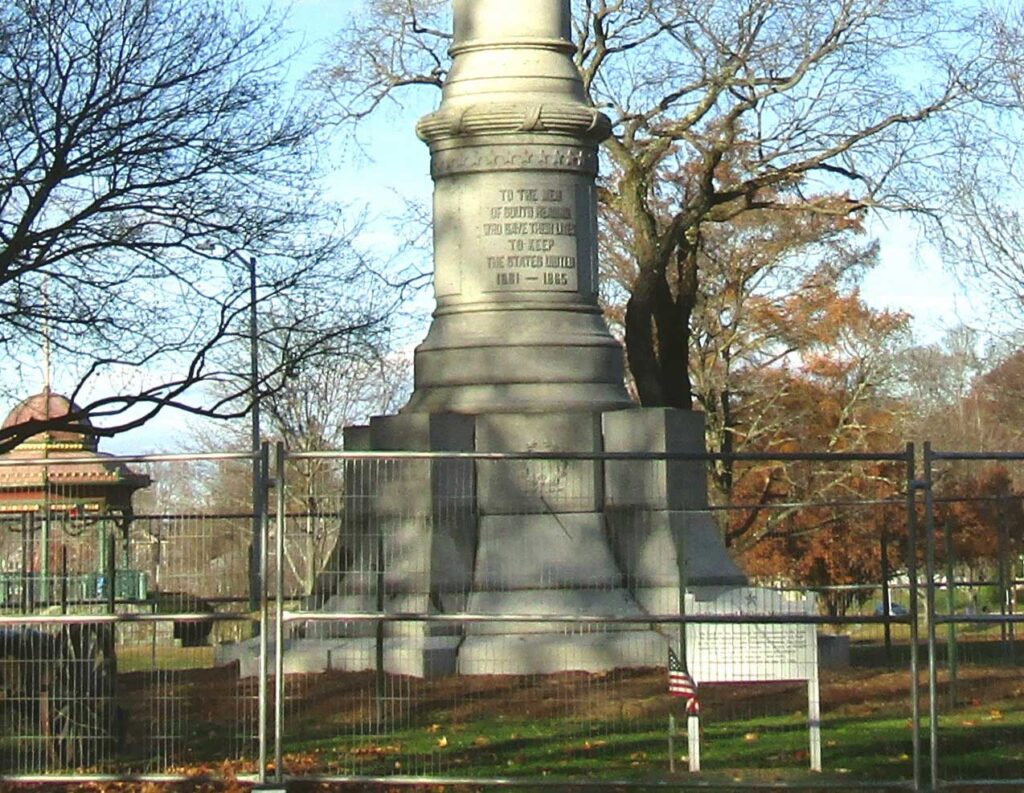
The four granite figures that have stood on the lower level of the 60-foot Soldiers and Sailors Monument are missing. But they will be back. For the first winter in 121 years, the statues will be spending the season indoors, being expertly repaired and restored at the studios of Deadalus, Inc. in Watertown.
It’s all part of a complete restoration of the nearly century and a quarter year-old monument dedicated to the men who served in the Civil War. The restoration fulfills a promise made on a bright June day in 1902, when dignitaries from around the region, including the Governor and our Congressman, came to Wakefield to witness the dedication of the imposing memorial.
Amid much pomp and circumstance on that day, local businessman Harvey B. Evans, on behalf of the monument committee, turned custody of the monument over to the Board of Selectmen.
“To them and their successors, we entrust the care and keeping of this memorial,” said Evans, owner of the L.B. Evans shoe factory on Water Street. “As long as the granite shall endure, may it be a reminder of what it cost to preserve the Union.”
One hundred and twenty-one years later, the Town Council assigned the Public Works Department the task of assessing what it would take to reverse the ravages of time and ensure that the granite memorial will endure and serve as a reminder for many generations to come.
An expert consultant was called in to assist the DPW with assessing the monument’s condition. DPW Director Joe Conway also recognized Town Councilor Robert Vincent, a U.S. Navy veteran, for his research and advocacy on behalf of the restoration project.
“We were fortunate to receive a favorable recommendation from the Capital Planning Committee and our request for $300,000 was approved by a vote from Town Meeting,” Conway said. “From there we went out for proposals and got interest from all over The U.S. and even Canada. Ultimately, we executed a contract with Daedalus, Inc., from Watertown.”
When Harriet Newell Flint died in 1896, her will left $10,000 towards the creation of a soldiers’ memorial. The town put the money in the bank to earn interest while a committee was assigned to fulfill Mrs. Flint’s wishes.
The committee chose the Van Amringe Granite Company of Boston to build the monument. The company had built many prominent Civil War memorials throughout the United States, including monuments at Gettysburg and Antietam. Well-known Sculptor Melzar Hunt Mossman (1846-1926), himself a Civil War veteran, is credited with designing the monument.
But age and more than a century of New England weather have taken a toll on the stately memorial, especially the figures of the soldiers and sailors. Enter Deadalus, which for over 30 years has provided hands-on conservation and restoration of prominent sculptures and monuments. Daedalus was already familiar with the local monument, having done an assessment years ago for the Wakefield Historical Commission.
Last month, Daedalus removed the four statues weighing a half ton each for restoration and repair at their Watertown studios. The restoration project will also include refinishing the iron fencing around the memorial and the cleaning and treatment of the two cannons near the base of the monument.
According to DPW director Conway, there is no evidence of major structural deterioration to the monument itself, outside of the damaged figures. Some repointing will be required around the base where the figures stand. Over the next year, Daedalus has committed to restoring the monument to its condition on that perfect June day in 1902 when it was first unveiled.
Visitors by the thousands arrived that morning by train and electric trolleys, according to the June 18, 1902 Wakefield Daily Item. A contingent of invited guests went to the train station to meet Massachusetts Governor Winthrop Crane, whose arrival from Boston was greeted by the firing of salutes by a military battery.
The parade began at Cyrus Wakefield’s old Town Hall at the corner of Main and Water streets. Lt. Colonel Edward Gihon led a parade featuring an estimated 1,000 veterans from posts in Wakefield, Melrose, Stoneham, Woburn, Saugus, Reading and Malden as they marched through the streets of the town before arriving at the Common. Among the marchers were veterans of the Civil War, who would have been only in their mid to late 50s in 1902.
Opening the ceremonies on the Common, The Lynn Cadet Band played an overture of patriotic music and about 500 local school children sang “Speed the Republic.”
The large crowd saluting the flag as the children sang “The Star-Spangled Banner,” the Item said, “made a beautiful living picture.”
In his address, Congressman Samuel W. McCall decried mankind’s history of warfare over such things as religion or national boundaries. The Civil War, which the new monument commemorated, was a nobler conflict, he said.
“There was never a purer or more unstained cause,” he maintained, calling it “a war of self-preservation, not a war of conquest.”
McCall concluded his remarks on that day with a prediction.
“We shall not soon forget the lesson of the lives of the heroes we today commemorate,” he said, “and while that shall abide within us, the Republic will endure.”
The thousands of souls in attendance for the monument’s dedication on that June day in 1902 would doubtless be pleased to know that, even 121 years later, the town has not forgotten.