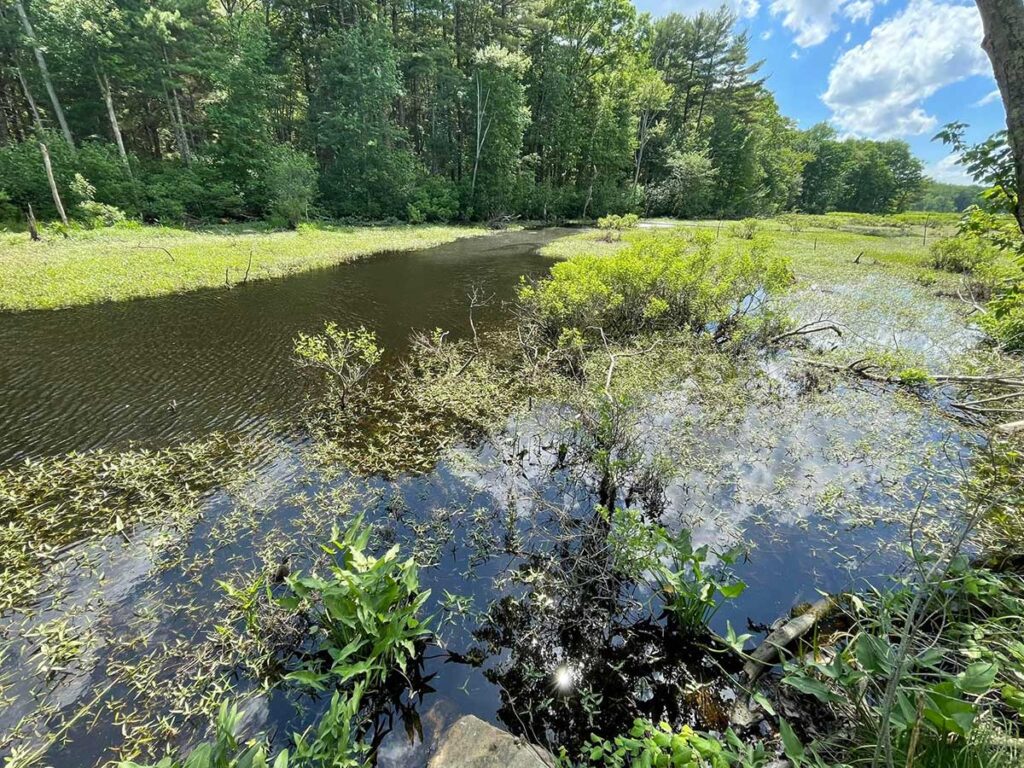
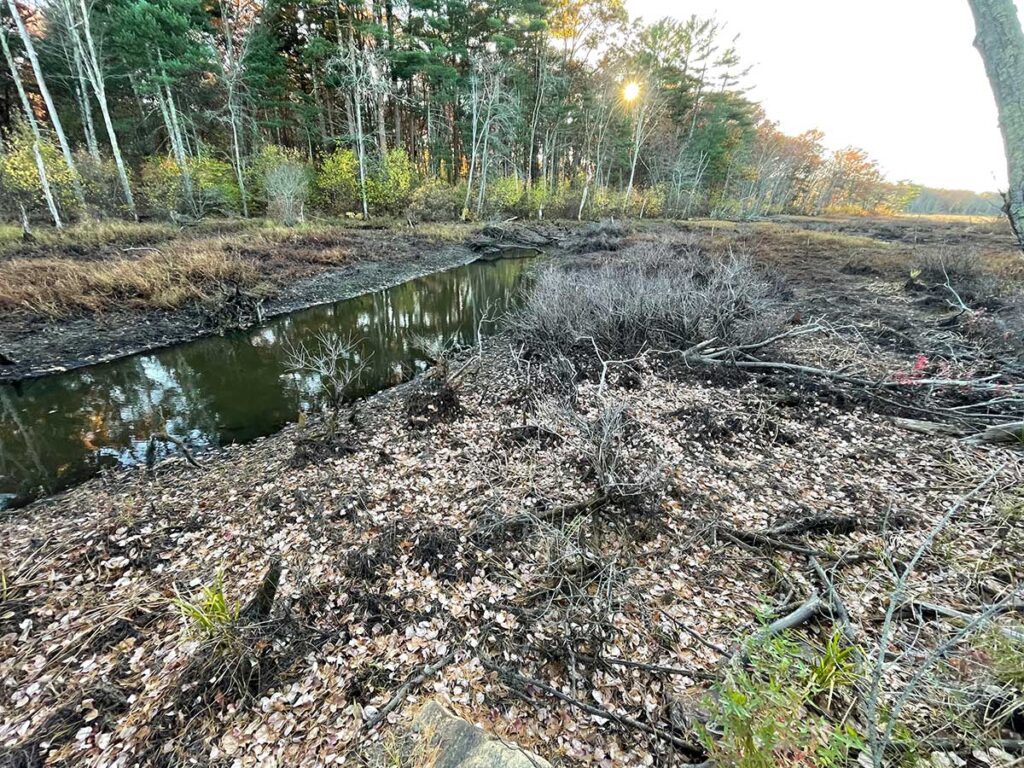
A LOOK AT Martins Brook in North Reading that is part of the Ipswich River Watershed during the summer of 2024 (top) and October 2024, which is when a significant drought occurred. (Ipswich River Watershed Association Photos)
By DAN TOMASELLO
LYNNFIELD — The Ipswich River is one of the most endangered rivers in the United States, and more has to be done to protect it.
That was the message Ipswich River Watershed Association (IRWA) Executive Director Erin Bonney Casey sent to a large group of attendees during a presentation held in the Meeting House on Jan. 29. IRWA Board of Directors President Ken MacNulty, who lives on Merrow Road, said he got involved with the nonprofit organization 10 years ago after reading an article about the Ipswich River being one of the most endangered in the United States.
“I thought this doesn’t make sense,” said MacNulty. “The Ipswich River has been named one of the most endangered rivers in the country not once, but twice. In most cases, the rivers are on that list because they are polluted. The Ipswich River, however, is not because of pollution. It is because the water is so good. And because it travels through or near 21 cities and towns, it is almost dry by the time it gets to the ocean. That is why it is endangered.”
Bonney Casey said the IRWA is a nonprofit organization that serves as “the voice of the Ipswich River.”
“We work to protect nature and make sure that there is enough clean water for people, fish and wildlife today and for our children and theirs,” said Bonney Casey. “We are trying to protect and restore our watershed. We are trying to undo past harms that we have willingly or unwillingly inflicted on the river. What that might look like is dam removals, right-sizing culverts and removing invasive species that we introduced erroneously to the environment. To protect the river, we are looking at future-proofing the river. We want to make sure it is healthy enough to withstand all of the challenges that it is going to face moving forward.”
Bonney Casey said the IRWA is “committed to this idea that we need to balance the needs of the people who live and work here with the needs of the environment.”
“We really believe that we can do both at the same time,” said Bonney Casey.
Bonney Casey said the IRWA led a “successful campaign” that resulted in Ipswich residents voting to remove the Ipswich Mills Dam last spring. After the dam is removed, she said it will help restore the river that runs from Burlington to Ipswich.
The IRWA has been examining climate change’s impact on the river and the watershed, Bonney Casey said. She recalled that the state had a significant drought last fall, which led to a number of brush fires across the North Shore.
“In a typical year, the flows in summer are lower than the flows in October,” said Bonney Casey. “This drought was severe, but the seasonality of this drought was really unusual. The fact it hit in the fall and went through December and January is surprising. It is reflective of that fact that our climate is becoming more unpredictable. It also points to the fact that our water management system has been in many ways structured to assume that summer is going to be our low-flow season and that is when droughts are going to happen, and everything is going to be recharged in the fall and winter. This drought makes me think that we shouldn’t be relying on that assumption anymore.”
In response to a question from Locksley Road resident Patrick Curley, Bonney Casey said most of the water people drink from the Ipswich River Watershed comes from wells.
“People think that wells are a separate system from rivers, and are not from the same system,” said Bonney Casey. “There are 350,000 people who drink Ipswich River water. We pull it straight from the river and wells located around the river. All of that water being pumped out is lowering the water table. When the water table drops below the bottom of the stream, the stream disappears and you just end up with a channel. Drought conditions can exacerbate that, but perennial streams historically don’t run dry. They run dry because we are artificially lowering the water table through all of the pumping that we are doing.”
Bonney Casey recalled that Lynnfield Center Water District ratepayers receive water from both the Ipswich River and North Coastal Basins via groundwater wells. She said the Lynnfield Water District provides water via the MWRA to South Lynnfield residents. She said ratepayers from both districts use more water during the summer because people are watering their lawns.
“There is a question about whether that is the best use of water when we are in conditions where there isn’t enough water available,” said Bonney Casey.
Bonney Casey said the North Shore Water Resilience Task Force is working to “identify and advance long-term solutions to improve water supply resilience and ecosystem health in the Ipswich River Watershed.”
“Those are both important goals for the task force,” said Bonney Casey. “It reflects our perspective that we have to do both at the same time. We have to have a secure and resilient water supply, and we also have to respect the needs of the ecosystem. This really is a novel approach because historically in Massachusetts, each town has their own independent water supply system and they make decisions on how they are going to manage their water resources independently of every other town. When everyone is making a decision in their best interest, you are setting yourself up for a lot of challenges such as having the river run dry. We are also having water supply issues with wells going dry. Towns have to issue water emergencies, and you get quality concerns when you have very low flows. The fact that all of these towns have signed an agreement and we are all going to talk collectively and collaboratively about what the regional solution to this regional challenge might be is really novel about this approach.”
Bourque Road resident Greg Pronevitz said residents with private wells frequently water their lawns when the LCWD implements outdoor watering restrictions each summer. He asked if private wells also affect the water table.
“It’s the same as if you were using a municipal well,” said Bonney Casey.
LCWD Water Commissioner Andy Youngren said the Massachusetts Department of Environmental Protection regulates water withdrawals from the Ipswich River Watershed. He noted that those rules do not apply to private wells.
“It would make sense for the DEP to step in and start regulating the private wells,” said Youngren.
Bonney Casey said the IRWA has had conversations with MassDEP about how the Water Management Act can be amended in order to make it “more sustainable and be more reflective of the conditions on the ground.”
“The Water Management Act is from 1986,” said Bonney Casey. “We live in an entirely different climatic world now, and our regulations should be updated to reflect the reality of the world that we are now living in.”
Bonney Casey said the IRWA supported the LCWD’s interconnection project that will allow the district to get supplemental water from the MWRA via Wakefield because it diversifies the district’s water supply.
“We participated in the public comment period in support of that project because it does take pressure off of the Ipswich River,” said Bonney Casey.
Bonney Casey said the IRWA is working with Bostik to remove the South Middleton Dam that the company owns.
“We are very supportive of removing outdated dams, so we have been helping Bostik with this project since 2008,” said Bonney Casey. “It is fully permitted and we are cautiously optimistic that it is going to be removed this construction season, which would be the summer.”
Bonney Casey said the IRWA is “really focused on restoring native fish populations” to the Ipswich River, particularly herring. She said herring migrate from the ocean to rivers in order to spawn.
“This river used to be a very productive river for herring, but we are down to around 1,000,” said Bonney Casey. “Dams on the river are a big barrier for fish.”
Bonney Casey said the IRWA supports the town’s and LCWD’s decision to open up the Willis Woods conservation area on upper Main Street for passive recreation because it will allow more residents to see and use the Ipswich River.
“We are excited about the opportunities this is going to provide for more river-based recreation,” said Bonney Casey.
Bonney Casey said the reason why the Ipswich River is endangered is because it is “so intensively used.”
“We have to lessen how much water we are taking out of the river,” said Bonney Casey. “Those solutions are not easy to implement at all, such as how do we stop pumping the river in the summer. There are individual decisions that we can make when using water in our homes and in our gardens. We can make decisions about our demand individually, and we can talk to our town officials about how water is being managed and how we are developing in a sustainable way to make the most of the water resources that we have available.”
Bonney Casey also said it’s important for people to “push the state” to amend the Water Management Act.
“This organization is working on all of those levels to try and pull all of the levers at the same time to move us in that direction,” said Bonney Casey.

