By DAN TOMASELLO
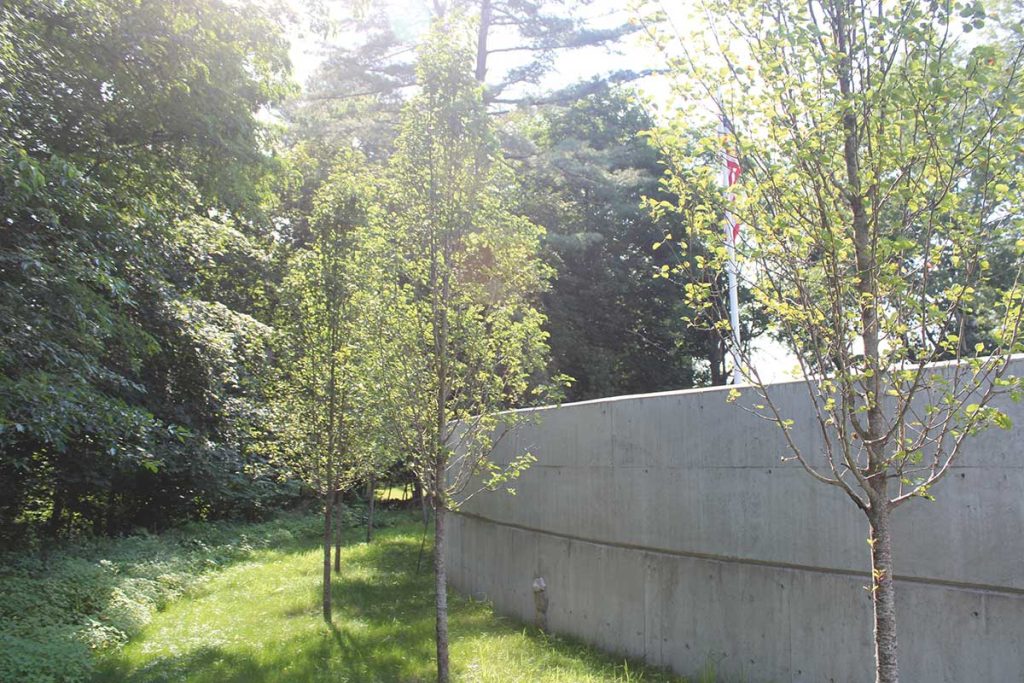
LYNNFIELD — The Conservation Commission recently voted to authorize the Department of Public Works (DPW) to remove nine invasive trees from behind the Veterans Memorial on South Common Street.
Retired DPW Deputy Director/Town Engineer/Tree Warden John Tomasz recalled that Veterans Memorial Committee Chair Joe Connell purchased nine Bradford pear trees that were planted behind the monument last year.
“Joe went down to Northeast Nursery to buy some trees,” said Tomasz. “Joe picked out the trees, they were delivered and we planted them. To be honest with you, I had no idea they were invasive. It’s my fault as the tree warden. We bought them from a big nursery and a legitimate nursery, and I didn’t know at the time we should not be planting those trees on public property.”
Connell said he met with two certified arborists at Northeast Nursery in February 2024.
“We went over about 43 different types of trees,” said Connell.
Connell said Northeast Nursery’s two arborists told him not to plant berry, elm or oak trees behind the Veterans Memorial because those trees’ root systems grow quickly, which could damage the monument. He said Northeast Nursery recommended that he purchase two types of pear trees, including the Bradford pears.
“They grow between three- and six-feet, which gave us the ability to put the trees five-feet behind the wall and they are 11-feet apart,” said Connell. “My recommendation to John was to go with those because of the root system itself. (Northeast Nursery) also recommended that because they grow so symmetrically that they will not grow towards the wall or over the wall.”
The Massachusetts Department of Agricultural Resources added the Bradford pear tree to the Massachusetts Prohibited Plant List in September 2024, which was two months before the Veterans Memorial’s public dedication last Veterans Day. The list “prohibits the importation, sale and trade of plants determined to be invasive in Massachusetts.”
“This ban also covers the purchase and distribution of these plants and related activities, and includes all cultivars, varieties and hybrids of the species listed,” the Massachusetts Department of Agricultural Resources stated on its website.
Connell said the Bradford pear trees were planted behind the Veterans Memorial before they were added to the Prohibited Plant List.
“They were put in prior to us even knowing the state was going to put them on the Prohibited List,” said Connell. “We didn’t try to sneak them in there.”
Connell noted that the Bradford pear tree is one of the over 900 types of trees that have been planted at Arlington National Cemetery.
“Those are not prohibited down in Arlington,” said Connell.
Conservation Commission Chair Donald Gentile thanked Connell for explaining how the Bradford pear trees were planted. He said the trees have to be removed because they are invasive.
“There obviously is a danger of planting invasive species, particularly near wetlands, because birds pick up the seeds from the trees, drop them into the wetlands and, all of a sudden, you have this invasive tree that can really take over the wetlands and the area around it,” said Gentile. “It is a difficult situation because this is an amazing project and was an amazing community effort to get this done. Unfortunately, there were nine trees planted between the memorial and the wetland that literature suggests could be pretty detrimental to the area. We are trying to come up with a resolution that doesn’t disrespect you, your efforts or the veterans.”
Gentile asked Connell if he was open to replacing the Bradford pear trees with trees whose root system will not damage the Veterans Memorial.
Connell said yes.
In response to a question from Conservation Commission member John Michalski, Planning and Conservation Director Emilie Cademartori said the commission issued two permits for the Veterans Memorial project because it abuts a wetland. She said the project’s size was decreased to make sure it did not go into the Wetlands Protection Bylaw’s 25-feet No Disturb Zone.
“At the time they filed for the construction of the memorial, the landscaping plan was going to be submitted at a later date,” said Cademartori. “We just never got a chance to review it. The landscaping hadn’t been chosen yet and it wasn’t shown on the plan. The only landscaping on the plan was actually shown not behind the wall at all, but on the front and on the sides. It just didn’t come back to the commission.”
Michalski agreed with Gentile that the nine Bradford pear trees have to be removed.
“It’s a pretty-well known invasive tree,” said Michalski. “It smells rotten when it flowers. It is awful.”
Planning Board Chair Page Wilkins thanked the Tree Committee for bringing the Bradford pear tree issue to both the Planning Board and the Conservation Commission “quite awhile ago.”
“This is town property abutting a wetland,” said Wilkins. “The Conservation Commission has jurisdiction and an obligation over this area. My understanding is that when this was first approved, changes were made and a planting plan was required to be submitted. That didn’t happen, but mistakes can be made and things can be forgotten. I appreciate all of the work the committee put into it, Mr. Connell especially. But we have a process, the process wasn’t followed and it’s an invasive tree. It’s really a no-brainer that these need to come out and be replaced. We have an obligation because it is town property. Both of our boards tell townsfolk all the time what they can’t do to their private property. We have to set an example.”
Wilkins said the Veterans Memorial is a “special place” in town, especially for military families such as hers.
“I think we should make this the most important and special place that it could be, and follow the rules of the town,” said Wilkins. “These trees were not on the (town’s) planting list. My board tells people they have to follow the planting list for the Tree Bylaw. These are not on the planting list.”
Wilkins proposed that some of the funds included in the town’s Tree Fund be used to plant new trees behind the Veterans Memorial once the Bradford pear trees are removed.
Veterans Services Officer/Veterans Memorial Committee member Bruce Siegel said Northeast Nursery’s arborists should have told Connell that the Bradford pear trees were invasive.
“It’s obvious that we need to take some action,” said Siegel.
While Siegel said the trees could be replaced, he also suggested that no new trees be planted.
“I question whether there is actually a tree out there that would be appropriate based on height, based on roots and based on depth,” said Siegel.
Connell said nurseries are still selling Bradford pear trees and sales will not stop until 2028. He also noted there are other Bradford pear trees planted on other town-owned properties.
“I think the argument is the town should be treated the way we treat private property,” said Cademartori. “If someone was looking to develop a landscaping plan for their property and came before this board for a permit, we would never have allowed these trees. It is just trying to be consistent.”
Gentile said the Massachusetts Department of Environmental Protection’s wetland regulations stipulate that only native species can be planted.
“That is our other issue because it technically runs afoul of that provision of the regulations too,” said Gentile. “And like Emilie said, if you are making residents live up to these standards, it is kind of tough to not stand up to the town and make them do the same thing.”
Planning Board member Kate Flaws said the town has an approved tree list that is part of the Tree Preservation Bylaw that can be used to identify potential replacements. She also said Siegel raised a valid point because not replacing the trees would allow more people to see the Pope-Richard Lynnfield Historical Center that is behind the memorial.
“That is another plus for removing these invasive plants,” said Flaws.
Tree Committee Chair Jane Bandini said the Bradford pear trees should be removed.
“There is also an option of placing trees in a different location and not behind the memorial itself,” said Bandini. “One of the issues is people have known for at least 30 years that this tree is a problem. This is nothing new. The problem is the nursery industry. They are in the business to make money. It is a very quick tree to promulgate, it grows quickly, it transplants easily and looks nice. They are going to keep selling it until someone tells them they can’t sell it, which is what this prohibitive law does. These are well-known problem trees and the people you spoke with at Northeast Nursery know it.”
Cademartori said, “The process for getting on the Prohibited Plant List takes three years.” She said the Massachusetts Department of Agricultural Resources held three public hearings before the Bradford pear tree was added to the list.
Bandini said the Bradford pear tree was almost added to the list 15 years ago.
“That list is for the nursery industry,” said Bandini. “They are the problem.”
After the discussion, the Conservation Commission voted to have the DPW remove the Bradford pear trees and have them replaced them with native trees.
During a subsequent Planning Board meeting, Cademartori said there is $70,100 in the town’s Tree Fund. The Planning Board supported Wilkins’ proposal that some of the money in the fund be used to replace the invasive trees.
“There should be no reason not to do this,” said Planning Board Vice Chair Amy MacNulty.