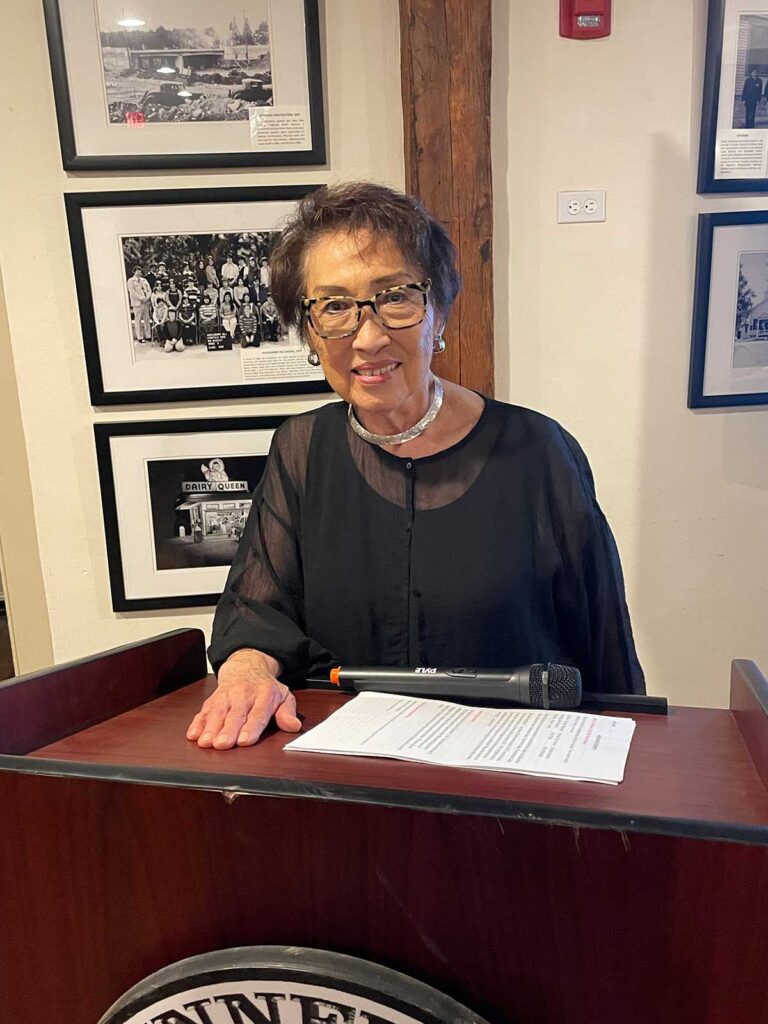
LYNNFIELD RESIDENT Joyce Fukasawa discussed her experience being detained in the Manzanar War Relocation Center during World War II in front of a large crowd at the Meeting House on Sept. 18. (Dan Tomasello Photo)
By DAN TOMASELLO
LYNNFIELD — Lynnfield resident Joyce Fukasawa shared her powerful story about living in a Japanese incarceration camp during World War II while a standing-room only crowd listened attentively at the Meeting House on Sept. 18.
Lynnfield for Love, the Lynnfield Public Library and the Lynnfield Democratic Town Committee sponsored Fukasawa’s presentation called “An Evening of History and Resilience” at the Meeting House.
Fukasawa, 87, said she and her family were sent to the Manzanar War Relocation Center in Owens Valley, California when she was 4-years-old. She did not leave Manzanar until she was 7.
“You wonder how anyone can remember anything all the way back to 4-years-old,” said Fukasawa. “I think it was because my normal routine was taken away overnight.”
Fukasawa was born in Costa Mesa, California in 1938. She said her father owned a refrigerated truck business that transported vegetables and fruit to Los Angeles. She said her mother owned a restaurant.
After Imperial Japan bombed Pearl Harbor on Dec. 7, 1941, Fukasawa recalled that President Franklin D. Roosevelt signed Executive Order 9066 on Feb. 19, 1942 that ordered Japanese Americans to be removed from their homes and be incarcerated at 10 detention facilities located around the country.
“They evacuated anybody who had one-sixteenth of Japanese in them,” said Fukasawa. “The thing about 9066 was it never said to incarcerate either Japanese Americans or people of Japanese descent. It didn’t say that, but they just assumed that. There was just panic during the war.”
Fukasawa said she and other Japanese Americans were given about a week to leave their homes.
“They closed down bank accounts, took away businesses and you had to make plans for your household’s goods,” said Fukasawa. “We left our things with a neighbor who were friends.”
Fukasawa said she and her family were taken to the Santa Anita Assembly Center that was located on a horse race track.
“We were there for two months from April to June 1942,” said Fukasawa.
Fukasawa and her family were transported 231 miles from Santa Anita to Manzanar on a U.S. Army convoy truck. She said the Japanese Americans who were transported to Manzanar were “all dressed up.”
“I remember sitting on the truck’s floor with my pet turtle that had died,” said Fukasawa. “I don’t know when my pet turtle died, but it might have been before we got to Santa Anita. I remember it being really cold.”
Fukasawa said her sister was born on April 12, 1942.
“I don’t remember having a little sister when we were in Costa Mesa, but I do remember my mother carrying a baby when we were on the convoy truck,” said Fukasawa. “I think she had the baby at Santa Anita. I am really not sure, and I am not sure if there is a way to find out. Maybe there is a birth record some place, but it wasn’t under the government’s property like the camps. She passed away the following November from meningitis.”
Fukasawa said Manzanar had an infirmary hospital. She had to go to the infirmary after she got fish bones stuck in her throat.
“I was thinking I would never go home because that is what happened to my sister,” said Fukasawa. “She went to the infirmary and never came home. It is a scary thing when things are not explained to you.”
Fukasawa said she, her family and other detainees lived in apartments that were located in barracks at Manzanar.
“The apartments didn’t have a wall in between,” said Fukasawa. “Some people hung sheets or blankets to divide this apartment from that apartment. Each apartment had one light bulb that hung from a chain and an oil stove. There was no running water. If we had to use the bathroom, that was in the center of the barrack. There were many times I went there by myself. There were guards in these eight watchtowers around the camp that had bright lights. They would put them on me as I was going the bathroom. It felt like someone was following me. It was the scariest thing. My father finally found some lumber, and made a little seat and put a bucket under there for me. We did bucket runs in the morning. When you are a kid, you are pretty adaptable and do what you have to do. I really don’t know what my mother did.”
Fukasawa said the eight watchtowers located over one-square mile were “manned by just one soldier.”
“They said it was to protect us, but the guns were pointed in,” said Fukasawa. “I don’t think it was to protect us.”
Fukasawa said she, her family and other Japanese Americans being detained were forced to use communal showers at Manzanar.
“Those weren’t easy,” said Fukasawa. “I was young enough that I could fit in the tubs that were made out of whiskey barrels. I remember the cork was missing, so I would stick my toe in the hole. And when I was even younger, I remember my mother even putting me in the laundry sink.”
Fukasawa said the Japanese Americans incarcerated at Manzanar were forced to eat in mess halls because the barracks didn’t have kitchens, and her father worked as a cook. She said there were people who later started farms at Manzanar.
“I don’t know where they got the pigs, cows, chickens, eggs and vegetables,” said Fukasawa. “Within three years, they were able to feed themselves. It’s amazing what people did with nothing. The people who were landscapers built some beautiful gardens. This is an arid area in the high desert. I don’t know where the water came from.”
Fukasawa said there were men who organized 100 baseball teams at Manzanar.
“It was their past time,” said Fukasawa. “It caught fire and just went everywhere. They were well-attended because there was nothing else to do.”
Fukasawa said a group of detainees started the Manzanar Free Press newspaper.
“It was pretty much a sheet piece of paper and eventually became a full-sized newspaper,” said Fukasawa. “I don’t know where they had it printed.”
Fukasawa said Ralph Lazo, who was of Mexican American and Irish American descent, was the only person in Manzanar who was not Japanese American. She said he went into the camp when he was 16 after he found out his friends were being taken there.
She said Lazo advocated for Japanese Americans to receive reparations for being incarcerated during World War II. After President Ronald Reagan signed the Civil Liberties Act of 1988, survivors received $20,000 each.
Fukasawa, her parents and her 6-month-old brother were released from Manzanar in April 1945.
“They gave $25 to each person to leave,” said Fukasawa. “They took us on a bus from Manzanar to Reno, Nevada.”
Fukasawa and her family relocated to Denver, Colorado. She majored in Arts at Colorado’s Women’s College, and worked as a certified interior designer for 40 years. She is an active member of the Lynnfield Art Guild.
After Fukasawa and her family were released from Manzanar, she said her parents and the friends she made there “never talked about” their experience.
“It has helped me a lot to talk about it because we didn’t talk about it,” said Fukasawa. “My parents never ever talked about it. They never even reminisced. It was almost like it never happened.”
Fukasawa showed a slideshow of different pictures from Manzanar and other camps during her presentation. She noted that the mission of the Bainbridge Island Japanese American Exclusion Memorial in Washington is “Nidoto Nai Yoni,” which she said translates in English to “Let It Not Happen Again.”
“I think we all do this so it won’t happen again,” said Fukasawa why she and other Japanese Americans have shared their experiences about being detained during World War II. “We can’t let it happen again.”
After Fukasawa concluded her remarks, she was given a thunderous round of applause. She thanked Lynnfield for Love, the Lynnfield Library and the Democratic Town Committee for sponsoring her presentation.

