The following was submitted by Yes for Melrose, the political action group advocating for the passage of a Proposition 2 1/2 override at the city election on November 4.
MELROSE — Under the limits of the state Proposition 2 ½ law, no matter how much costs rise, Melrose’s primary revenue source — our property tax levy — only increases 2.5% a year, plus limited new growth. The law was designed to keep taxes predictable, while giving the voters the power to approve local tax increases (through override votes) to fund the services they need. Over time, increases in unavoidable costs – like health insurance for employees – have regularly exceeded the allowed 2.5% increase, making it difficult for cities and towns to fund schools, public safety, and municipal services without seeking periodic overrides to bridge the gap. In fact, 45 Massachusetts communities, including Medford and Arlington, have passed overrides in the past three years.
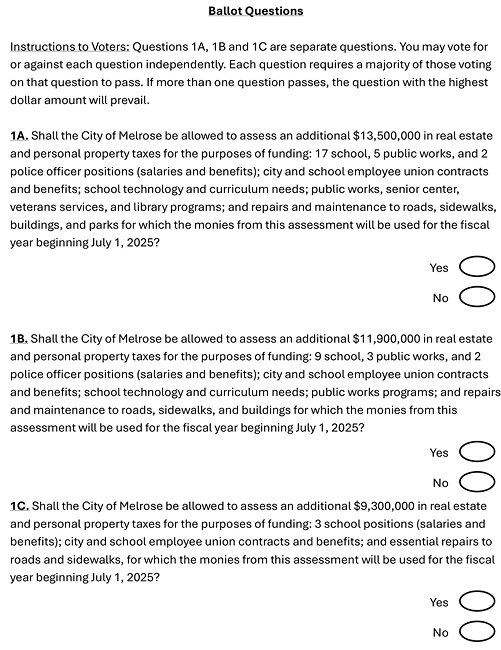
The Massachusetts Division of Local Services (or DLS) allows only certain types of override questions to be put to the voters, and the DLS website (www.mass.gov/info-details/proposition-2-12-overrides-exclusions) explains each format. This year, Melrose is using the “tiered” override model, which lets voters select the level of services they want to support. Voters are asked to vote YES or NO on each of three levels of funding via three ballot questions. The three levels are summarized as follows:
• Question 1A – $13.5 million: Strengthen. Substantially restore essential city and school services and positions, and invest in infrastructure.
• Question 1B – $11.9 million: Repair. Partially restore essential city and school services, reversing some recent job and program cuts.
• Question 1C – $9.3 million: Stabilize. Stabilize services at the current reduced levels, preventing further cuts.
Mayor Jen Grigoraitis’ Finance Task Force was formed “to take public feedback and make recommendations concerning revenue plans and potential override questions.” This group unanimously recommended a tiered question because it provides options to voters, explains what can be achieved by different funding levels, and allows them to choose the path forward for our community. The City Council unanimously voted to put this to the voters, and every member of the City Council has since endorsed a yes vote on all ballot questions, as has every member of the School Committee.
On November 4, voters will be asked to vote YES or NO on each of the three questions. However, it is important to note that only one question can take effect. The question with the highest dollar amount that gets more than 50% of yes votes will prevail. The amounts are not added together, even if more than one question passes. If more than one question passes, only the highest dollar amount that gets more than 50% of yes votes will take effect.
Voters should understand that if they want to see the top level of override funding go into effect ($13.5 million), it is still best to vote yes on all three questions, down the ballot, rather than voting yes only for the top amount. This is because, if the top level does not pass, and strong supporters only vote yes on question 1A ($13.5 million), then they have not helped pass the second best option, question 1B ($11.9 million).
All options are estimated to provide sustainable funding for the items listed in the ballot questions through the end of fiscal year 2029. A “no” vote is not neutral. If all questions fail, the city and schools will be forced to make additional cuts next year. The city has estimated that we will face at least $4 million in additional cuts, and no restoration of services, in FY27, with deepening cuts in future years.
You can learn more on the Yes for Melrose website at www.yesformelrose.org. There you can also find a tax calculator for your property, frequently asked questions (and answers), and upcoming volunteer opportunities. Yes for Melrose is a multi-generational, non-partisan campaign supporting a tax override to fund public resources for every Melrose resident. The campaign thanks every resident for learning more and for engaging in civil discourse on this issue.


