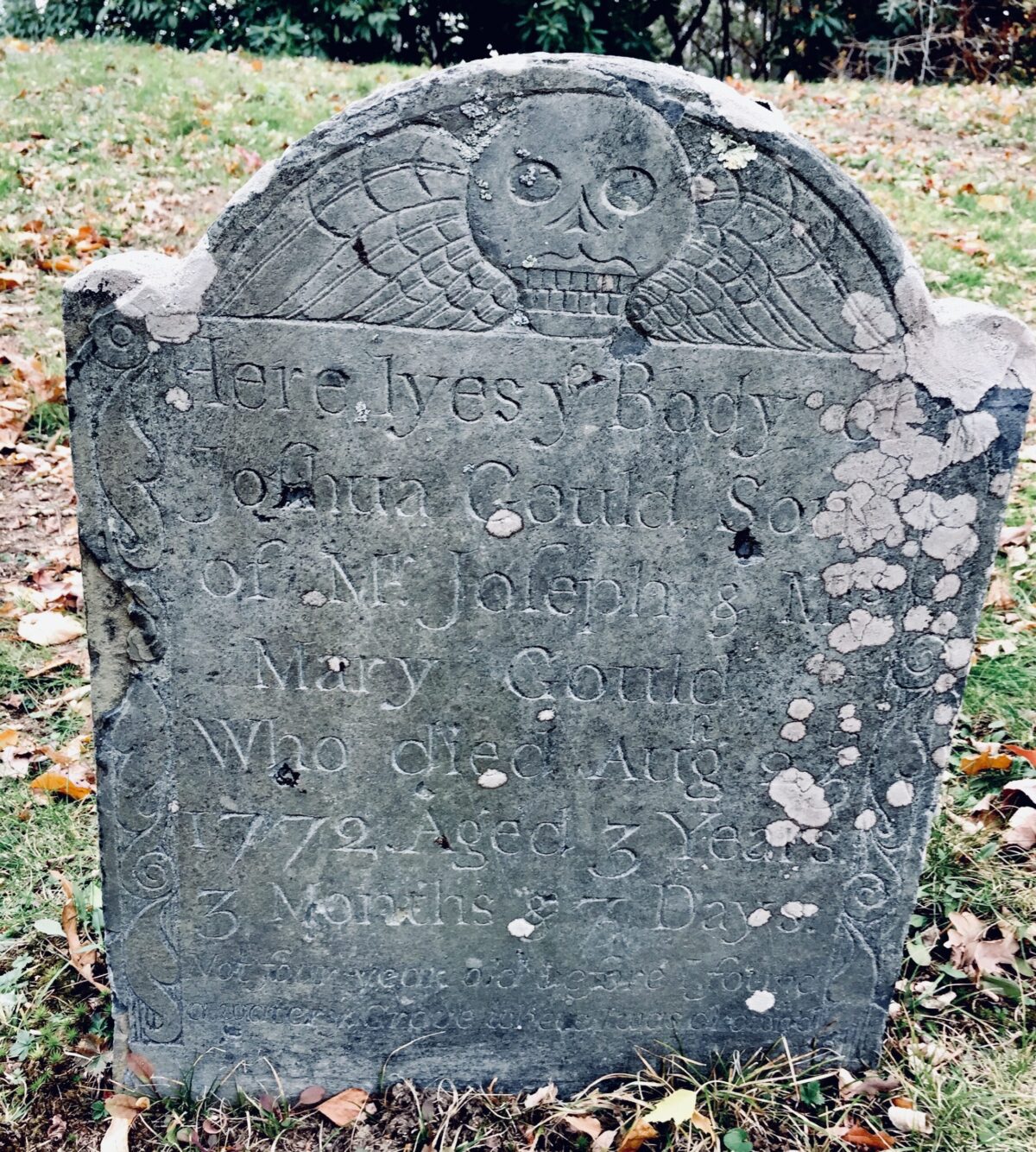
Stories from Old Burying Ground: Remembering young Joshua Gould

JOSHUA GOULD drowned in the Great Pond, now known as Lake Quannapowitt.

By NANCY BERTRAND

Wakefield’s Old Burying Ground is like an outdoor museum, filled with ‘artifacts’ reaching back to the town’s beginnings. Visitors can find the truest testament to those brave pioneers who first settled here, and their only monuments left standing.

In one way or another, the Old Burying Ground tells stories of those early settlers — their joys as well as their sorrows; their lives as well as their deaths. Through studies of the files of the Wakefield Historical Society and the Wakefield Historical Commission, it was possible to ‘resurrect’ some of their stories and, with the help of the Wakefield Item, to share them.  

Yesterday we shared a gravestone in the Old Burying Ground that was moved from the original town cemetery, on what is now the Town Common near the Lake.

That graveyard was established when the town itself was born in 1644 and was likely used to bury Rev. Henry Green, the first minister, who died in 1648, followed by Francis Smith in 1651, Jeremiah Sweyen in 1658, but town records only noted the deaths of “freemen” (white men property owners, members of the church.) No attention was paid to the deaths of women, of children, of indentured servants, or slaves.  (Readers might be surprised to learn that in 1652, the town — that then included Reading and North Reading — had 20 enslaved people living here, out of a population of about 200. That number held steady through the next 100 years although the white population steadily grew.  In 1754 there were 20 non-white persons in town; in 1765, 34 ; in 1783, 12.)

The cemetery that we regard as today’s “Old Burying Ground” was established in 1689 after the town’s ‘new’ meeting house was built in the approximate location of today’s First Parish Church — but the older graveyard continued in active use for years and years. 

The last gravestone that we definitely know of from today’s Lower Common is the subject of today’s photo. Dated to 1772, it can be found today at the end of the continuous line of stones at the far western end of today’s Burying Ground, with other stones moved from their original location.

It is the gravestone of little Joshua Gould, son of Mary and Joseph Gould, dated to 1772, and is quite poignant:

“Not four years old before he found

A wat’ry grave in which he drowned.”

Little Joshua was three when he drowned in the Great Pond.  He probably wandered down from his home on Salem Street.  Joseph Gould, Joshua’s dad, was a carpenter and built many houses on Salem Street. Joshua’s heartbroken parents commissioned this stone to mark their son’s grave near the Lake.

Little Joshua’s gravestone has the winged skull motif on the top and the  wording is carefully chiseled.  The white markings that you see on the gravestone are biological activity (lichen) that can be scrubbed off gently with a soft bristle brush and water.

Remember Joshua, and all of the estimated hundreds of those who are buried in one of our most beautiful areas, the shore of Lake Quannapowitt.

Come back Monday for another gravestone and another story, as the Wakefield Historical Society celebrates our favorite month — October!

Shopping Cart
  • Your cart is empty.
Scroll to Top