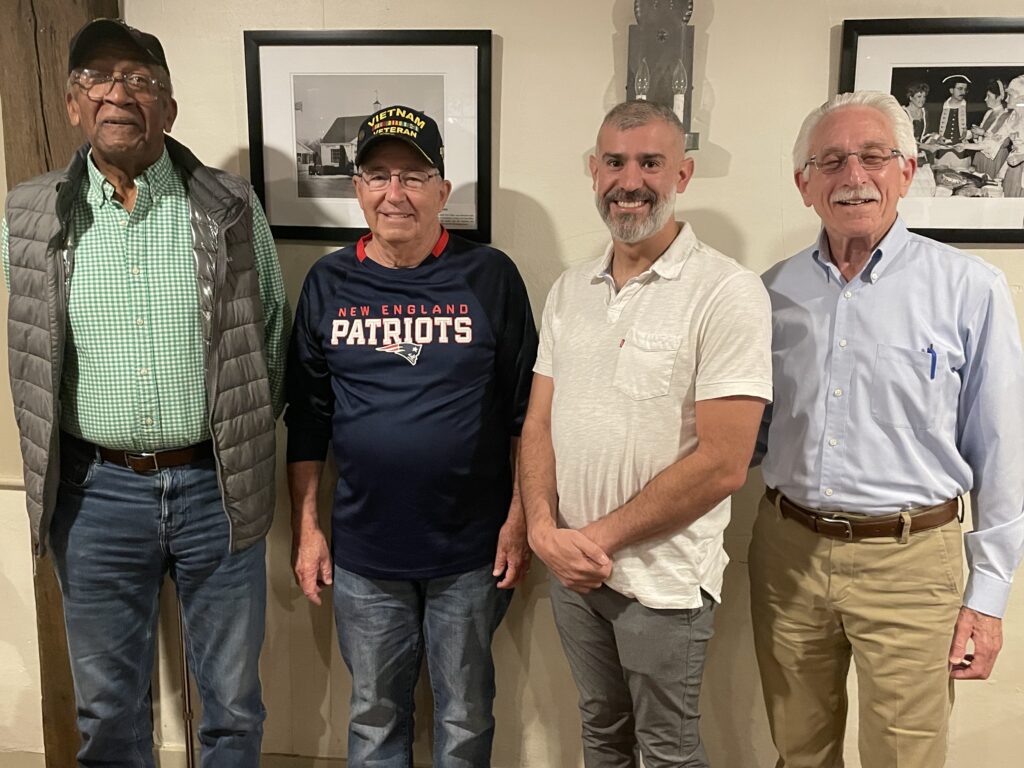
VETERANS, from left, U.S. Navy/U.S. Marine Corps veteran Dr. Donald Monteiro, U.S. Army veteran Ralph Reid, U.S. Marine Corps veteran Chuck Leach and U.S. Navy veteran/Veterans Services Officer Bruce Siegel shared different experiences while serving in the military during a presentation held in the Meeting House on Oct. 8. (Dan Tomasello Photo)
By DAN TOMASELLO
LYNNFIELD — Four veterans discussed their experiences serving in the military during a presentation held in the Meeting House on Oct. 8.
Over a dozen residents attended the Lynnfield Public Library’s “Living Legends: Stories from Lynnfield’s Veterans” presentation. U.S. Navy/U.S. Marine Corps veteran Dr. Donald Monteiro, U.S. Army veteran Ralph Reid and U.S. Marine Corps veteran Chuck Leach shared different stories about their experiences while serving in the military. U.S. Navy veteran/Veterans Services Officer Bruce Siegel moderated the panel discussion and discussed his experiences as well.
After Monteiro was drafted and went through boot camp in 1966, he ended up going to hospital corpsman school. He served in the Vietnam War.
“I don’t know how I was selected to be a corpsman,” said Monteiro. “Corpsmen at that time did not have a high survival rate in Vietnam. There are guys who I went to school with who never came back.”
Reid enlisted in the U.S. Army after graduating from the Wentworth Institute of Technology. He decided to enlist because he wanted to work in the construction-surveying field and was looking to gain some professional experience.
“I figured I should be pretty safe and I doubted that I will end up in Vietnam,” said Reid. “I went through basic training at Fort Belvoir, and went directly to Bien Hoa in Vietnam.”
Leach served in the U.S. Marine Corps for six years, where he served in active duty as well as the Marine Corps Reserves. He said the U.S. Constitution inspired him to enlist and serve as in the U.S. Marines.
“I am super passionate about this document,” said Leach while holding a copy of his pocket-sized U.S. Constitution.
Siegel served four years in the U.S. Navy from 1968-1972.
“I decided join the service because I wanted to serve my country,” said Siegel. “I chose the Navy because I wanted to see the world. It was four years of my life I wouldn’t trade for anything.”
After Reid was deployed to Vietnam, he was sent to a U.S. Army base in Kon Tum in April 1968.
“It was at the end of the Tet Offensive, and Kon Tum got hit really bad,” said Reid. “I spent months there fixing up the airport and rebuilding barracks. I learned that the United States rented every piece of land that we used from the Vietnamese government, and I surveyed a lot of it. That bothered me. I didn’t know why we had to pay.”
Reid and other service members had to deal with 102-degree temperatures, monsoons, dust and mud throughout Vietnam’s challenging seasons.
“It was quite an experience,” said Reid. “There was one bridge that we replaced two or three times. We would build it and they would blow it up. Snipers were always a problem.”
After Monteiro was deployed to Vietnam, he was asked to run a hospital unit.
“I was just a kid and I didn’t know anybody,” said Monteiro. “We just had the Tet Offensive, where there were mass casualties. It was a tough job. I had to make the decision of who to prioritize to go to the operating room. You had to base it on how many resources you had. That was the toughest part.”
Monteiro performed a surgery on a solider from Alabama who lost one arm and portions of both legs.
“He was really a mess and was almost gone,” said Monteiro. “I walked past him and said he said, ‘If you are going to touch me, let me die.’ I said, ‘well you made a mistake. I am the one who makes the decision.’”
Monteiro told the other hospital corpsman to bring the injured Alabama soldier to Room 6. He was forced to perform the surgery on him because “all of the surgeons were tied up.”
“I was out of high school, had six weeks of training and I was a full-blown surgeon,” said Monteiro. “I said put him to sleep and I will do the job. I operated on him, and he made it.”
Monteiro also said he gave the injured Alabama soldier a unit of his blood while he was recovering in the intensive care unit because his blood type was not available in the blood bank.
“I took a pint of my blood and put it in him,” said Monteiro. “I went to the recovery room a few days later, and he was not happy. I started to walk past him, backed up and said, ‘Young man, I had a choice that you were going to live or you were going to die. You are going to live.’”
Monteiro’s experience serving as a corpsman inspired him to become a doctor. He worked as an obstetrician-gynecologist in Melrose and Malden.
Reid and Monteiro both noted that many service members abused alcohol and drugs during the Vietnam War.
“There were drugs everywhere,” said Reid. “There is nothing worse than being next to a guy in a trench who can’t stand up. There was an awful lot of that.”
Monteiro said drug use was “a big, big problem” in Vietnam. If soldiers were driving on Vietnam’s very small roads and one of them stuck their hand out of the window, he said they could grab drugs.
“When you brought your hand back, you had so many drugs you didn’t know what to do,” said Monteiro.
Monteiro said Vietnam was “a strange war.”
“We would have barbecues on the beach and we would barbecue in the middle because the bullets couldn’t reach the middle,” said Monteiro.
Leach recalled his experience serving in Afghanistan. While he originally thought he was going to lead a platoon as a lieutenant, Leach ended up being named as an advisor for the Afghan National Army. He said a Afghan National Army colonel told him, “We have been at war our all lives, why are you here?”
“That question stuck with me,” said Leach. “I said I don’t know, but I am going to try my best and help as best as I can.”
Leach recalled that U.S. forces were going to turn over a $150 million project to the Afghan National Army that ended up being delayed after a contractor held up a blowtorch to the building and concluded its “fire rating wasn’t up to U.S. standards.”
“The juxtaposition of our American mindset and applying it to a foreign country is something I had to come to terms with,” said Leach. “I said while I am here, I am going to do the best I can and stick with my morality and integrity. I was going to do the right thing and do the best I can. I am a Cub Scout leader and an Eagle Scout, and I have always tried to do my best. That is what I did.”
Leach said contractors working for the National Security Agency (NSA) and Central Intelligence Agency (CIA) had “backpacks full of hundreds of thousands dollars in cash that was just being thrown out to people left and right” to pay for things such as service members or contractors accidentally running over an Afghan’s goat.
“There was also fraud, waste and abuse that comes with that,” said Leach.
Leach said he was able to get special purpose visas for a group of Afghan interpreters he befriended.
“I was able to exit a group of people I became close with over that nine-month period,” said Leach. “I brought them back to Boston, watched their children grow, watched them get jobs and I helped them out. I feel good about the small part I was able to do and help people in the world. I tried to do the best I could.”
Siegel was not deployed to the Vietnam War. He served on an LST, which is an amphibious ship, as a fire control technician. He said that he “operated equipment that essentially tracks targets that works in conjunction with the guns on the ship.”
“We took Marines who had already been to Vietnam out on cruisers to essentially play war games,” said Siegel. “They were close to being discharged, and they needed to be sent somewhere. We practiced all the time. We landed all over the Mediterranean and all over the Caribbean. I was very lucky. I got to visit Spain, Greece, Italy, Gibraltar, all of the Virgin Islands, Panama, Columbia and Jamaica. I went to a lot of nice places and I met a lot of nice people. I made some friends who I will always remember. It was a tremendous opportunity.”
In response to a question from a woman in the audience, Reid said Veteran War veterans were not given a warm welcome when they came home. He ended up losing a couple of good friends when he returned home in September 1970.
“Things are much better now,” said Reid. “I would have never worn a Vietnam War veterans hat like this when I came back. People acknowledge it now and thank me. I appreciate it.”
Monteiro agreed.
“A lot of the Vietnam vets couldn’t wear their uniform when they came back,” said Monteiro. “We just got out of the war and when we got to the airport, we had to change clothes immediately.”
Leach and Monteiro both said most soldiers try to stay out of the politics while they are deployed. Leach said the men and women serving “do it for their own personal reasons.”
“It is not always political,” said Leach. “The politics are more like a reality TV show to me.”
Monteiro said the veterans who have served “will defend this country to no end.”
“Most people felt it was their civic duty,” said Monteiro.
After the presentation concluded, the presentation’s attendees gave the four veterans a round of applause.
Siegel thanked Monteiro, Reid and Leach for participating in the panel discussion. He also thanked the Lynnfield Library, particularly Director Abby Porter, for hosting the presentation.

