Tax increase on tap 

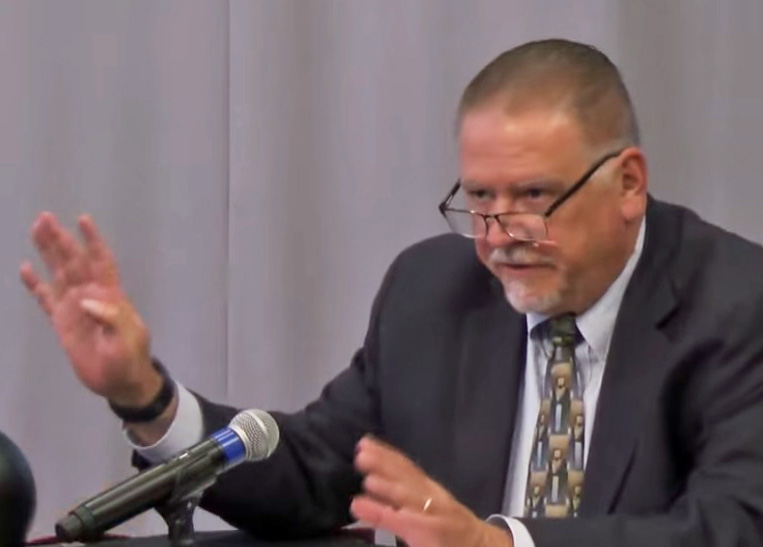
DIRECTOR OF ASSESSMENTS VICTOR SANTANIELLO

By MARK SARDELLA 

WAKEFIELD – Your property taxes are going up, in part because this year (FY2026) is the first year that the borrowing for the new high school will significantly impact local taxes.

Director of Assessments Victor Santaniello appeared before the Town Council last night as the board held its tax classification hearing for FY2026. No taxpayers attended or spoke at the public hearing.

Santaniello explained how the tax rate is calculated. He noted that Massachusetts General Laws Chapter 200 allows Wakefield to shift more of the tax burden from residential properties onto the Commercial/Industrial classes of properties. Historically, he reminded the board, Wakefield has chosen the maximum allowable shift to afford residential taxpayers the lowest share of the tax burden allowed by state law.

Under that maximum shift, the residential tax rate for FY2026 will be $11.75 per $1,000 of assessed value. The commercial/industrial property (CIP) tax rate will be $22.42 per $1,000 of assessed value.

That means that the average single-family home in Wakefield, valued at $825,700 will pay $9,702 in property taxes this year, up from $8,886 in FY2025.

The average commercial property value in Wakefield is valued at $1,634,083 and will pay $36,636 in property taxes this year, up from $35,627 in FY2025.

Santaniello noted that FY2026 is the 12th year of the full Debt Exclusion for the Galvin Middle School. It adds $2,373,892 to Wakefield’s tax levy. The FY2026 Wakefield Memorial High School debt exclusion amount is $5,174,259. Combined, Santaniello explained, the debt exclusions add $7,548,151 to the town’s FY 2026 Tax Levy. The debt exclusion adds $0.85 to the residential tax rate & $1.63 to the CIP Rate. The debt exclusion cost to the average single-family home is expected to be $701. The debt exclusion cost to the average commercial property is $2,665, Santaniello noted.

The Town Council voted to approve the FY2026 tax rate as presented by Santaniello.

The board also took several related votes. Santaniello explained that under state law, a maximum exemption of 25 percent may be adopted as an open space discount. However, the town has never voted a discount for open space since no properties have been identified which meet the legal definition. The Town Council voted not to adopt the open space discount this year.

The board also declined to adopt a 35 percent residential exception. Santaniello explained that only a handful of communities including Boston, Cambridge, Chelsea and Brookline have adopted this exemption, which he said would not work well in a town like Wakefield.

Finally, the Town Council declined to adopt a small commercial exemption of up to 10 percent of property valuation for commercial properties. Santaniello said that the Assessing Department is unaware of any business meeting the requirements for this exemption.

Santaniello noted that this past year was the sixth year that the town has offered a senior citizen discount. He said that 243 seniors applied and 227 were approved for the tax reduction. The total amount granted was $478,157, with the average individual tax reduction coming to $2,043.

This exemption added $0.07 to the residential tax rate, which translates into an increase of $60 on the average single family tax bill to help local seniors continue to remain independent and age in place, Santaniello said. 

Shopping Cart
  • Your cart is empty.
Scroll to Top