Voters pass a $13.5M override; city services to be ’strengthened’

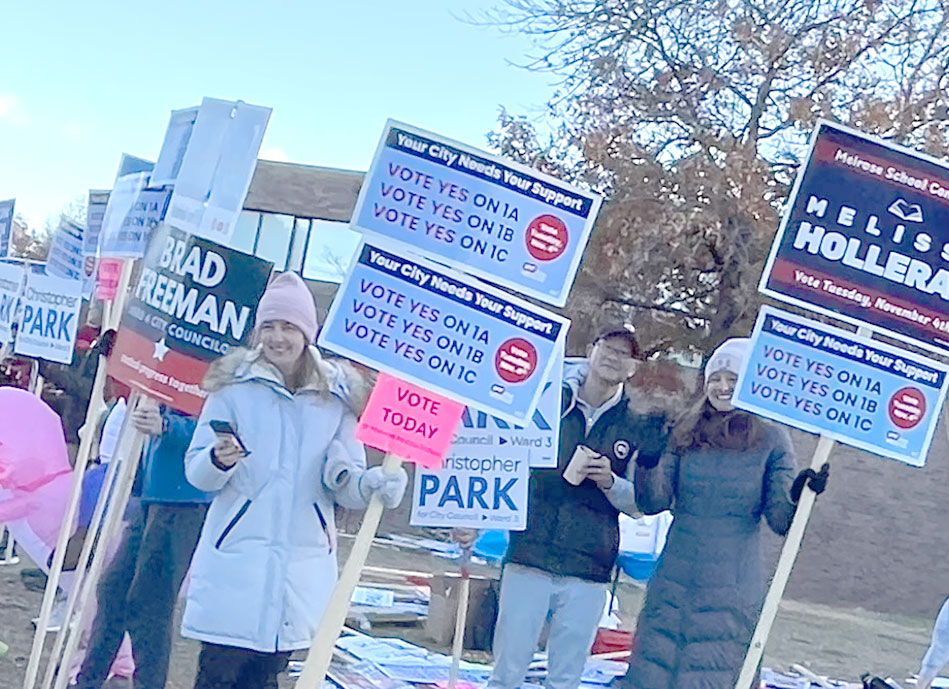
Supporters of a Proposition 2 1/2 override campaign for more tax revenue. Voters passed an override of Proposition 2 1/2 at all three levels of the three-tiered question on November 4, 2025.

MELROSE — After a spirited community conversation, voters decided Tuesday to raise $13.5 million more each year in property taxes to help the city and the schools function in a very comfortable way.

Voters passed an override of Proposition 2 1/2 at all three levels of the three-tiered question. According to the manner in which the state has set up these option questions, the most expensive tier with a majority voting yes passes. It does not have to receive the most votes, which happened in Melrose this week.

All results are unofficial. Of 21,471 registered voters, 51.94 participated in Tuesday’s election.

Question 1A, the tier that sought the most money from taxpayers, passed by a 54.36 percent to 45.63 percent margin. Question 1B, which sought $11.9 million more a year from taxpayers going forward, passed by a 56.54 percent to 43.45 percent margin. The least impactful question to taxpayers, 1C, passed 58.83 percent to 41.17 percent. The number of voters who passed the override on Question 1C was 6,508. Those voting yes on 1B were 6,265 and 6,018 voted yes on 1A.

Now that the override has passed at the most expensive level for taxpayers, city and school officials can begin restoring and strengthening services. Specifically, 17 school, five public works, and two police officer positions (salaries and benefits); city and school employee union contracts and benefits; school technology and curriculum needs; public works, senior center, veterans services, and library programs; and repairs and maintenance to roads, sidewalks, buildings, and parks.

For the average single-family home in Melrose (assessed at $817,630), taxes will increase by $1,374 per year.

Over the course of five months, opponents and supporters of raising more property taxes to run the city and its school made their respective points very clear.

Opponents, led by the group Keep Melrose Affordable to All, argued that the 3-tiered Proposition 2 1/2 question on the ballot, by design, used psychology to mislead and confuse voters.

In a letter published in the Weekly News on October 24, KMATA writes “The highest dollar amount wins, as long as it gets over 50 percent of the vote (even if a lower dollar amount gets a higher percentage of votes).

“(Mayor Jen Grigoraitis) claims a $4 million shortfall for her proposed budget, yet is asking for up to $13 million.

“Melrose voters already said NO to an override in June, 2024.

“Melrose voters passed an override in 2019, yet promises of how the money would be spent were not kept. The Beebe school was never opened and will now be a police station.

“An override is a permanent, compounding tax increase that remains in place year after year, with no end date.

“Debt exclusions are used for specific projects with a clear end date. Melrose is still paying off the middle school project, and we will start seeing an increase on our tax bills when we begin paying for the public service buildings in 2027 (an average of $875 per year per resident).

“Melrose city taxes increase by 2.5 percent each year, compounded. A debt exclusion raises taxes above the 2.5 percent limit.

“Proposition 2 ½ was passed in the early 1980’s to limit government overreach when the inflation rates reached 13 percent. Inflation is under 3 percent and predicted to continue to fall.

“Melrose has only passed two overrides in 42 years, (the most recent in 2019), yet real estate values have skyrocketed and our public schools have a good reputation.

“Overrides are unpopular: Since 1990, close to 60 percent of override votes have failed.

If the override passes, it will be retroactive to July 1, 2025.

“In Fiscal Year 2022, there was a $2.2 million shortfall in the school budget that had to be borrowed from free cash after Mayor Gregoritis, then the city council president, was part of the leadership responsible for approving that fiscal year’s budget and oversight process. This was explained away as ‘an accounting error.’  Now, she is asking for more money.

“Melrose Public Schools student population is declining. It has gone from 3,947 to 3,666 since October, 2024 – a total of 281 students. Moreover, we never received the additional 400 students the city predicted in the last override.

“Melrose has been well below the state average for per-pupil spending for decades, yet has a good reputation. According to PublicSchoolReview, Melrose ranks in the top 20 percent of Massachusetts school districts overall. The high school has a 97 percent graduation rate, and a 67 percent AP participation rate.

“Melrose 10th graders outperformed the state on MCAS tests, as reported by the Weekly News 10/3/25.

“In FY 2026, Melrose Public Schools received $13,285,756 in Chapter 70 (school) funding, marking an increase of $597,750, a 4.7 percent increase FY 2025 City of Melrose. This funding covers approximately 30 percent of the total school budget.

“To support education, donations can be made to the Melrose Education Fund or The Melrose Education Foundation.

“In FY 2026, Melrose received $761,294 in Chapter 90 (road) funding, a significant increase from the $520,000 allocated in FY 2025, and an approximate 46.4 percent rise in funding year-over-year. The money is being used for city roadway work.

“Annual trash fees have gone up from $200 to $430,” KMATA continued.

The override advocacy group was Yes for Melrose.

Also writing in the October 24 paper, Yes for Melrose representatives stated, 

“Melrose has a choice to make about what kind of community we are and can be. It’s not an easy choice, but it could not be more important. Across virtually every metric, school spending, city spending and tax rates, Melrose lags behind neighboring communities and in many cases behind state averages, according to the Massachusetts Department of Elementary and Secondary Education and the Massachusetts Department of Revenue.

Chronic underfunding has a price. With dozens of positions cut in our schools and city departments in recent years, the city has reached a breaking point.

“Budget cuts have meant the elimination of positions across public works, fire, police and city hall departments. Reductions in staff and services have been felt everywhere from public safety, to the Milano Senior Center, to library hours, to reduced city yard hours, to reduced roadway line painting and sign replacements and even the elimination of trash barrels at public parks. We have cut support for local economic development and many other services residents want and need. In short, we have a problem.

“In our schools, cuts have affected everything from class size to course offerings. Teachers have longer student rosters and classrooms have fewer trained adults. When we underfund, we also lose support staff who help struggling students early on which leads to higher needs (and costs) down the road. It can also mean we fail to keep pace with peer districts in course offerings, extracurriculars and technology and that we burn out our teachers and lose them to better-funded districts. The override isn’t about funding bells and whistles in the schools. It’s about the basics, reading support, keeping students current in STEM subjects, manageable class sizes and the staff to meet students’ needs and prepare them for college and careers.

“As a community, a very challenging question we need to ask ourselves is this what’s next? If the override does not pass, what will we be forced to cut next year? City leadership has already explained that at least $4 million in cuts will be needed next year alone with deepening cuts in the years to follow. And that says nothing of the many public employee contracts that will need to be settled in the next two years, including for our teachers.

“Thankfully, we have a choice at this crossroads. This override and a YES, YES, YES vote will allow Melrose to think beyond scarcity and year after year of tough budget cycles. All options are estimated to provide sustainable funding through the end of fiscal year 2029. Together we can stop the cuts. Together we can restore some of the vital positions in our schools, public works and public safety, while also repairing our roads, sidewalks, parks and fields. Together we can strengthen Melrose for all residents.”

Shopping Cart
  • Your cart is empty.
Scroll to Top