
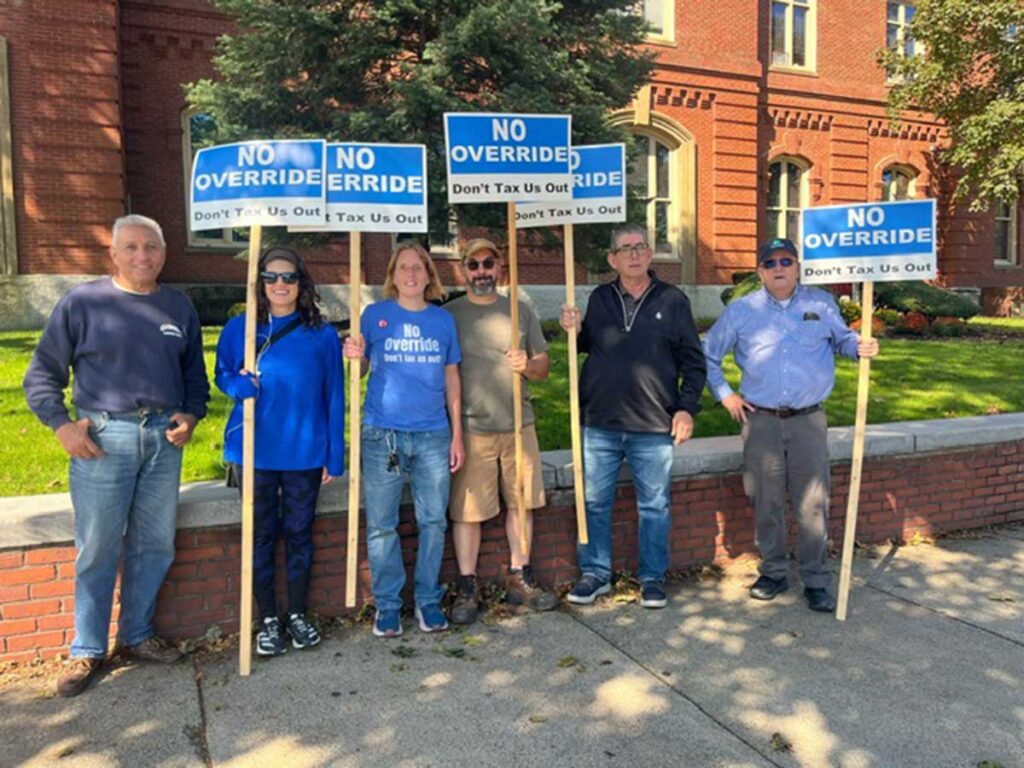
MELROSE — There is a critically important City Election approaching on November 4, with races to be decided for City Council and School Committee.
Just as, if not more, importantly, a three-tiered Proposition 2 1/2 override question also will appear on the ballot.
Overrides — which if passed raise people’s property taxes — are always difficult to ask for. No one takes them lightly.
Over the last few months, we have presented in prominent parts of the paper the position of supporters of the override question.
This week, we give override opponents a turn. Following are some questions and answers submitted to the paper by Keeping Melrose Affordable To All.
We at Keeping Melrose Affordable To All are a diverse coalition of young and old, new and long-time residents, ones with school age kids or even grandkids in the schools, from a wide range of incomes and political views, who all love Melrose and want to keep it open to all.
What are some of the challenges your group faces?
The main challenge is going up against City Hall and well-funded special interests: For example, during the 2024 override campaign, the Yes group spent over $18,000, while our grassroots effort spent only $1,800. Another challenge is that some residents feel pressured to keep quiet about opposing the override, fearing backlash.
What are the main concerns of your group?
For starters, we recognize that the 3-tier ballot question, by design, is confusing and misleading. Most voters don’t understand that the highest dollar amount getting over 50% of the vote automatically wins, even if a lower amount gets a higher percentage of the vote. Additionally, this type of question uses psychology to make people feel that they must choose at least one of the three options, and that they are compromising by choosing the lowest dollar amount.
People with and without financial means feel pressured to support the override when in reality, it’s okay to say NO. We don’t want to see seniors or working families pushed out of Melrose. We don’t want renters forced to pay even more. Overrides are permanent, add economic strain on the vulnerable, and we have seen that past promises tied to tax increases haven’t always been kept. We know that, for many, these are uncertain times as Massachusetts has a higher unemployment rate than the national average. Our campaign’s goal is to keep Melrose equitable and open to all, not just those who can afford to keep paying higher taxes. After all, our city motto is “One community open to all.”
Are you the only group opposed to the override?
No. We’ve recently seen other lawn signs with the slogans, “Demand Accountability” and “Demand Transparency.”
What about claims from the “Yes” campaign?
Some of the biggest arguments from Yes for Melrose are that Melrose spends “less per pupil,” that there have been significant teacher layoffs, and that funding needs to “keep up with inflation.” Melrose has always been well below the state average for student spending, yet our schools continue to have a good reputation. Melrose 10th graders continue to outperform the state average on MCAS tests, as posted in the Melrose Weekly on 10-3-25. Student data shows that outcomes are not automatically tied to bigger budgets, and that responsible budgeting, coupled with community-based support, can strengthen schools without placing an outsized burden on taxpayers. In terms of school staffing, data from the Melrose school administrative offices shows that from August 2024 to present, there have been more hires than resignations/separations/retirements, reflecting an increase – not a decrease – in positions. When proposition 2 ½ passed in the 1980’s, inflation was 13%. Currently, it’s below 3% and falling. Inflation is variable and has not historically been tied to city budgets in the past.
The Yes for Melrose campaign makes assumptions of what could happen if the override attempt fails again, instead of looking at hard facts and historical data. Those promoting the failed 2003 override attempt made similar predictions that never came true – that the schools would go into receivership or that home values would fall.
Who would be most affected by the override?
Seniors and residents on fixed incomes would feel the greatest impact. Over 28% of Melrose’s population is 65 or older, and nearly 7% of them live below the poverty line—defined as earning less than $15,045 a year. In a high-cost state like Massachusetts, that amount leaves very little room for rising taxes. In addition, student enrollment in Melrose public schools has gone from 3,906 to 3,666 from October 2021 to October 2025; and this year’s incoming Kindergarten class is the lowest it’s been in over 12 years. Millennials are in their mid 40’s now. We may very well be seeing the beginning of a contraction in the student population as we did when that same generation left school. In addition, people are living longer and having fewer children, so we need to balance the needs of everyone.
Aren’t there tax relief programs available for seniors?
Yes, but they’re limited. Melrose offers tax deferrals, a senior work-off program, and a new Elderly & Disabled Tax Relief Fund. However, these programs only reach a small number of people. For example, the work-off program placed just 49 residents last year, and the relief fund offers a one-time benefit of up to $500 per recipient. While helpful, these programs don’t come close to offsetting the scale of an override’s permanent impact. They also do not help our renters who are struggling in an ever increasing rental market. Plus, many of our residents already rely on Melrose’s two church-based food pantries as well as the weekly food-assist drops at all of the senior housing complexes.
How does Melrose’s tax rate compare to other towns?
Melrose’s residential tax rate has gone down, but that’s misleading. Property values have risen sharply, so the average homeowner is already paying more than in previous years. An override would push bills even higher—and unlike one-time fees, overrides compound over time. By law, the city can raise taxes 2.5% every year, and that percentage is applied to ever-increasing property values. Plus, new development has already brought in significant additional revenue for the city.
But aren’t nearby communities paying more?
Comparisons can be misleading. For instance, Wakefield’s taxes include trash pickup, while Melrose homeowners pay an extra $430 each year for that service. As Melrose trash is now an Enterprise Fund, it can increase at any time. Saugus and Stoneham spend millions on student transportation that Melrose doesn’t face. Malden, meanwhile, has a student population where 75% are in high need, which means that they get significantly more state funding. These towns face very different financial circumstances, making side-by-side comparisons unfair.
How heavy is Melrose’s current tax burden?
According to state data, Melrose ranks 108th out of 351 Massachusetts municipalities in residential tax burden—placing us in the top third statewide. Residents already shoulder more of their income in property taxes than most communities across the Commonwealth.
How much would the override increase tax bills?
For a single-family home assessed at $817,630, the annual tax increase would be:
• $948 under the lowest override tier
• $1,210 under the middle tier
• $1,374 under the highest tier
And that’s not including the money for the public safety buildings project that we will start paying next year, which on average will be about $877 each year; and the increased trash fee of $430 per year.
Is the override temporary?
No. Overrides are permanent. Once added to the tax base, they don’t expire—they compound year after year. That means the cost will continue to climb long into the future, regardless of a household’s ability to pay. Remember, even without an override the city gets an automatic 2.5 % increase in funding each year.
Didn’t residents approve an override before?
Yes. In 2019, voters supported an override with a promise to fund opening the Beebe School, which is now being converted into a police station. That history makes some residents skeptical about whether new override funds will be used as promised.
What’s the alternative?
Responsible budgeting, along with donating to the Melrose Education Foundation or the Melrose Education Fund, offer more equitable ways to invest in schools without saddling homeowners with permanent tax hikes. Unlike an override, these funds can only legally be used for Educational needs.
How else can the community support education?
Beyond taxes, organizations like https://thebridgemelrose.org connect residents with volunteer opportunities. In 2024–25, nearly 2,200 people had active volunteer clearances, and 735 CORIs were processed—about 100 more than the year before. This shows strong community engagement without permanent tax increases.
Bottom line—why vote no?
Residents already face one of the higher tax burdens in the state. Adding a permanent override would hit seniors, renters, and working families hardest—people who are already struggling to keep up. The override is economically burdensome and offers no guarantees, while alternatives exist that don’t rely on permanent tax hikes.
Answer at the ballot box: Vote No, No, No on the override.
Where can people go for more information?
Residents can visit keepingmelroseaffordable.org for details, updates, and resources.