
By MARK SARDELLA
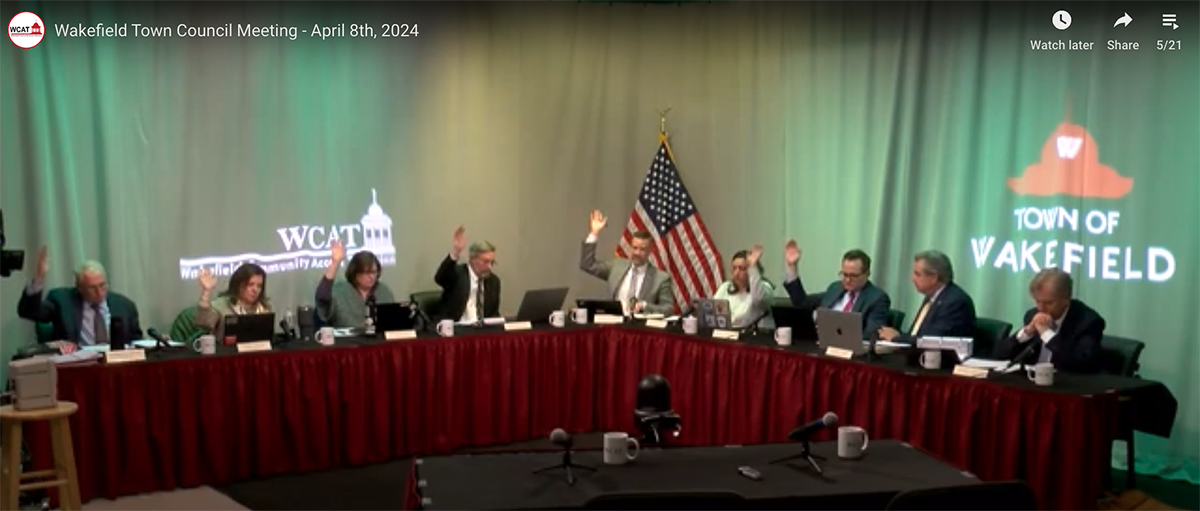
WAKEFIELD – The Town Council violated the Open Meeting Law at its April 8, 2024 meeting when it voted to take steps to become designated as a “Climate Leader Community,” a state program through which communities voluntarily commit to certain climate and clean energy benchmarks.
The Massachusetts Attorney General’s Office determined that the Town Council violated the law after receiving a complaint on June 7, 2024 from local open government advocate Scot McCauley.
Among the items slated for discussion at the April 8, 2024 Town Council meeting was one listed simply as “Climate Leaders,” which then-Town Councilor Julie Smith-Galvin had asked to be placed on the meeting agenda.
McCauley’s complaint alleged that the agenda listing, “Climate Leaders,” was not specific enough to advise the public of what the board planned to discuss.
The Attorney General’s Office agreed. In a letter sent to Town Counsel Thomas Mullen last week, Assistant Attorney General Carrie Benedon noted that the Open Meeting Law requires public bodies to list topics to be discussed at a meeting with “sufficient specificity to reasonably advise the public of the issues to be discussed at the meeting.”
The Attorney General’s letter goes on to explain that, “We generally consider a topic to be sufficiently specific when a reasonable member of the public could read the topic and understand the anticipated nature of the public body’s discussion.”
The April 8, 2025 Town Council agenda failed to meet that legal threshold, the Attorney General’s Office determined.
“The topic as posted provided no information as to what ‘Climate Leaders’ referred to, let alone the nature of the Council’s discussion,” the Attorney General’s letter stated. “The meeting notice did not even reference the Climate Leader Communities program by its correct name nor otherwise indicate that ‘Climate Leaders’ referred to a state program to which the Council would consider applying, as opposed to, for example, an opportunity to recognize influential climate advocates or a discussion of the local climate. Therefore, the Council violated the Open Meeting Law by posting an insufficiently specific notice for its April 8 meeting.”
After McCauley filed his complaint last June, Town Counsel Thomas Mullen wrote to the Attorney General’s Office defending the Town Council. Mullen asserted that no violation of the Open Meeting Law occurred because the Town Council agenda was posted in conjunction with “backup material” that described what was to be discussed under the “Climate Leaders” agenda item with sufficient specificity to satisfy the law.
The Attorney General’s Office disagreed with Mullen’s argument, stressing that the law requires that the meeting agenda itself must be sufficiently specific to inform the public of the topic to be discussed.
“We acknowledge the Council’s assertion that additional information regarding the Climate Leaders program, including the full PowerPoint presentation that was presented during the meeting, was posted online in advance of the meeting,” the Attorney General’s letter notes.
“[T]he separate posting of additional detail or documents pertaining to a discussion topic does not impact our consideration of whether the notice itself complied with the Open Meeting Law’s specificity requirement,” the AG’s letter continued. “Even for public bodies that use a website as their official notice posting method and therefore may post supporting documentation online, the meeting notice itself must include the level of specificity that the Open Meeting Law requires.”
The Attorney General’s finding also addressed McCauley’s request that the town be removed from commitments related to the “Climate Leader Communities” program because of the board’s illegal discussion and vote to pursue the program. The Open Meeting Law authorizes the Attorney General, upon finding a violation of the Open Meeting Law, to “nullify in whole or in part any action taken at the meeting.” But the Attorney General stopped short of that.
“In this instance, however, after speaking with the Council’s attorney as well as further reviewing the requirements of the Climate Leader Communities program, we are satisfied that the Council’s vote at its April 8 meeting did not bind the Town to any additional expenditures or undertakings,” the AG’s letter states. “The Town has already applied for, received, and utilized the technical assistance planning grant. Additional commitments, such as implementing a Zero-emission Vehicle First Policy or a 2050 Fossil Fuel-Free Commitment, as well as applying for recognition as a Climate Leader Community, will necessitate further action by the Council. Therefore, we decline to nullify the Council’s vote at its April 8 meeting.”
The Attorney General’s finding was summed up in the concluding paragraph:
“For the reasons stated above, we find that the Council violated the Open Meeting Law by posting a notice for its April 8 meeting that was insufficiently specific. We order the Council’s immediate and future compliance with the Open Meeting Law and caution that a finding of a similar violation in the future may be considered evidence of an intent to violate the Law.”
Town Council meeting agendas are set by the chairman. At the time of the April 8, 2024 meeting, the chairman was Jonathan Chines. The push for Wakefield to join the state Climate Leader Communities program came from the Environmental Sustainability Committee.
At least one Town Councilor raised concerns about the lack of transparency regarding the “Climate Leaders” agenda item during the discussion at the April 8 meeting.
Councilor Edward Dombroski objected to the fact that the Town Council was hearing the proposal for the first time at the end of a four-hour meeting, adding that there should have been a wider public discussion of the financial and practical ramifications of the commitments the town will be required to make.
“I think it’s a dangerous idea at this point in time,” he said. “I think it would be elected official malpractice to commit the town in this way. It feels like it’s being forced through at the eleventh hour.”
Councilor Michael McLane also raised concerns at the meeting. “I’m very skeptical about the costs,” McLane said.
Ultimately, the Town Council vote was 5-2, with Dombroski and McLane opposed.
In a separate ruling last week, the Attorney General’s Office declined to review an Open Meeting Law complaint filed by McCauley on Sept. 24, 2024 against the Environmental Sustainability Committee related to an ESC meeting held on Aug. 10, 2023.
In this complaint, McCauley alleges that the Environmental Sustainability the Committee created a subcommittee to draft a Town Meeting warrant article proposing the adoption of a specialized energy code and that this subcommittee violated with the Open Meeting Law by failing to post meetings, agendas or minutes.
Without deciding whether the ESC did in fact create such a subcommittee, the AG’s Office declined to review the complaint because it was filed more than 30 days after the violation occurred or could have been reasonably known.