
Published July 3, 2019
By MICHAEL GEOFFRION SCANNELL
NORTH READING — The Friends of Flint Memorial Library presented “Lizzie Borden and the Forty Whacks,” a play by Fran Baron on June 19 as part of their annual meeting.
Two actors playing multiple parts – including Lizzie herself and defense attorney George Dexter Robinson, former Governor of Massachusetts – bring the audience immediately back to the events of August 4, 1892 and Fall River’s most infamous resident and the gruesome axe murder of her father and stepmother. The group describes their effort as “edutainment.”
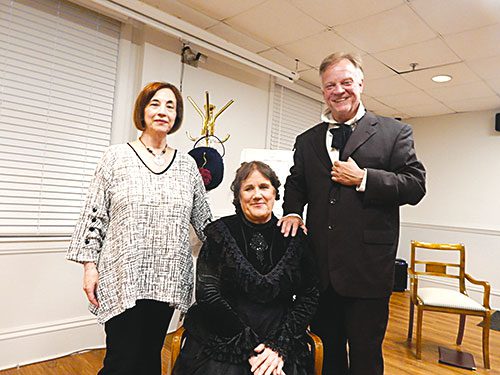
Through the portrayals of actor Joseph Zamparelli and actress Lynne Moulton, the audience, which is the soon-to-be the jury, learns that Lizzie and her sister lived with their father, stepmother and a live-in maid, whom they call Maggie simply because their last maid was called Maggie. Her real name, Bridget Sullivan, was deemed by the Bordens to be too Irish-sounding.
Many in the house were ill on that fateful day, perhaps from the nine-day-old mutton broth they had for breakfast. By all accounts, Mr. Borden was not a good person. Though wealthy, he was quite miserly; his house did not have electricity or indoor plumbing although both were readily available. He was not a particularly good father.
Not long before the murders, he had killed his grown daughter Lizzie’s pets more or less in front of her as a punishment. Mrs. Borden was not the biological mother of the two daughters and apparently there was resentment between them because Mr. Borden had given a house from his many properties to one of the stepmother’s relatives. Lizzie did not speak to her stepmother after that.
Lizzie Borden’s only alibi for the murders was that she was eating pears in the loft of the barn at the time of the killings. Her sister Emma was away, but might have returned by streetcar. The maid was supposedly ill in her room. There was a mysterious man in brown hanging around, but Lizzie was the only one who saw him.

There was a lengthy question and answer period. Some in the audience were very knowledgeable of the case, having been to Fall River and taken the tour. Then came the “jury’s” chance to weigh in. The vote was close but in the end, Ms. Borden was once again found innocent.
Many in attendance believed she could have done it and may have done it, but that the commonwealth had not proven it beyond a reasonable doubt.
Even though the crimes occurred more than 125 years ago, speculation about the murders has remained a topic in American popular culture; her legend has been recounted in films, theatrical productions, literary works, and the “Lizzie Borden took an Axe” rhyme.
Lizzie and her sister did, in fact, inherit their father’s estate after the younger Borden’s acquittal and they moved into a local mansion. At some point the sisters had a falling out and never spoke again. In the end, when Lizzie Borden passed she gave all of her estate to animal-related charities.
According to Zamparelli, the Lizzie Borden case was one that was studied intently by the O.J. Simpson defense team due to its reliance on circumstantial evidence.