
By HOLLY RAMER
Associated Press
BRETTON WOODS, N.H. (AP) — A young girl chatters to her mother as they descend Mount Pierce, her voice as bright and bouncing as her footsteps.
“You’re amazing!” she calls out to a slower couple she passes on the trail.
Until then, the couple has been focused on the physical effort of hiking, the precision required to step just so onto the rocks and around the roots. Motion, yes. Emotion, no.
But just for a moment, watching the girl disappear from view reminds them of their daughter.
How could it not?
—————
No one would blame Jorge Sotelo and Olivera Bogunovic if they stayed as far away as possible from New Hampshire’s White Mountains. Less than a year has passed since their oldest daughter Emily died cold and alone on Mount Lafayette in her quest to hike all 48 of the state’s mountains taller than 4,000 feet.
Though she had only a handful of peaks left, Emily had almost no experience with winter hiking, and officials say she was woefully unprepared for the brutal conditions that killed her. After an intensive three-day search, her body was found November 23 on what would have been her 20th birthday.
Within weeks, her family decided to create the Emily M. Sotelo Safety and Persistence Charitable Foundation. On Saturday, July 29, hundreds of hikers plan to participate in “Emily’s Hike to Save a Life,” a fundraiser organized by the foundation and Hiking Buddies, a non-profit that educates, prepares, and connects hikers. Dozens of teams will hike in the White Mountains and elsewhere, with some aiming to summit the remaining 4,000-footers on Emily’s list.
Her parents will be on Mount Lafayette, retracing her last steps.
In life, Emily pushed her mother out of her comfort zone and inspired her to become more giving, Bogunovic said. The hike is a continuation of that.
“It’s going to be a very emotional experience, but also a sense of accomplishment, that we accomplished what she wanted to accomplish, and in some ways, she does live on,” she said. “To build on what she had plans for … I think makes it a little bit easier to handle the tragedy.”
—————
Until they started preparing for the fundraiser, Bogunovic imagined hiking was “just a walk in the woods.” She had no idea how strenuous it would be.
“I thought, ‘Oh, it’s nothing, I’ll just run up that mountain and down,’” she said. “It was really an awakening for me.”
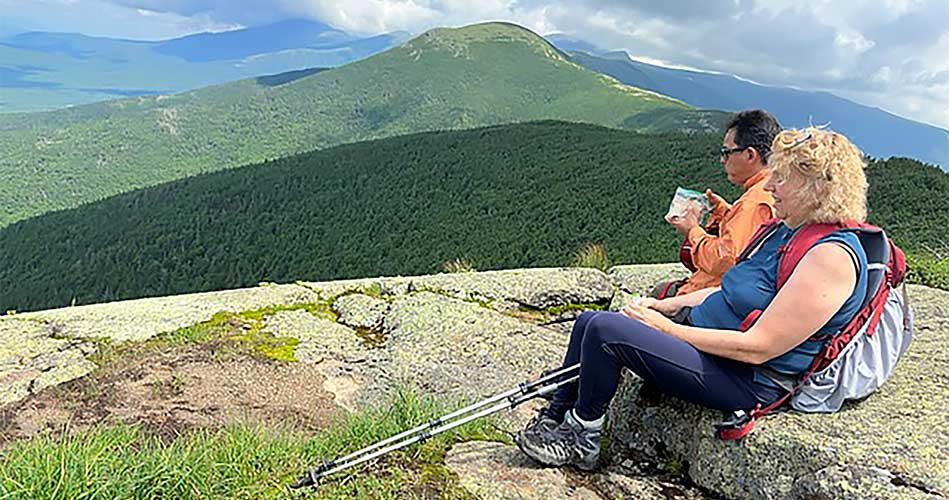
The couple started with flat terrain close to their home in Westford, Massachusetts, before working their way up, literally, to more challenging hikes. After tackling Mounts Monadnock (3,165 ft.), Pemigewasset (2,557 ft.) and Kearsarge (2,937 ft.), they attempted their first 4,000-footer, Mount Pierce (4,780 ft.), in late June. They didn’t reach the summit that day but succeeded on their second try a few weeks later. While experienced hikers typically finish the 6-mile trek in about four hours, Sotelo, 57, and Bugonovic, 56, spent close to 10 hot, humid hours on the mountain that day.
“At the beginning, I was thinking that you can take the mountain with the proper determination but then after attempting hiking a couple of times, I realized that determination is not going to make it,” said Sotelo, a gastroenterologist who practiced by climbing stairs at work. “You have to train for that.”
Accompanying them was Andrew Barlow, the moderator of the Hiking Buddies NH 48 Facebook page. Unfailingly patient, he talked the couple through trickier sections of the trail, answered Bogunovic’s frequent questions about how much elevation they had gained and told jokes along the way. “You haven’t stopped complaining since you got here” was one punchline, but the novice hikers had no complaints.
“They’ve never shown signs of exhaustion or anything like that. I’m sure they feel it, but they’re good at hiding it,” Barlow said. “It’s been a long process, but they’ve been great troopers.”
—————
The fundraiser was announced in April with a goal of collecting $50,000, but by early July, more than $75,000 had been raised. Hikers have committed to raising at least $250 each, and non-hikers who donate at least $150 can attend a post-hike celebration at the Bretton Woods ski area.
Hiking Buddies plans to use some of the money raised to offer free “buddy certification” training and safety courses for new hikers ages 17 to 25. Emily had joined the Hiking Buddies Facebook group a few months before she died, but had not participated in any of the group’s organized hikes, Barlow said.
“It just touched us that much more deeply, the fact that one of our own had died,” he said.
Among those participating in the fundraiser is Donna Lannan, 66, of Concord, who plans to hike Mount Eisenhower. A retired physical therapist who has been hiking in New Hampshire for 40 years, she said she signed up for the fundraiser to honor Emily and to support the volunteer search and rescue crews who risk their lives to save others. She was hiking in the White Mountains the day after Emily disappeared.
“It was very moving and upsetting to know that someone that young, by themselves, had experienced that kind of ending,” she said. “It was very emotional for me, just feeling badly for this young woman and her family.”
—————
Emily’s parents will head up Mount Lafayette on July 28 and spend the night at the Greenleaf Appalachian Mountain Club (AMC) hut. The next day, they’ll continue to the summit, where they will meet up with their younger daughter, Michelle, who plans to hike the two other peaks Emily had on her itinerary the day she died.
The months without Emily have been difficult, her parents said, and they’ve become hyper aware of other hiking accidents.
“Every time something happens, we think of her,” Jorge Sotelo said.
But he also thinks about Emily when he sees families and children having fun, like the cheerful young girl who passed them on Pierce. Bogunovic, meanwhile, said the encounter made her think about an older woman who reached out to her after Emily’s death to say Emily once encouraged her to keep going during a difficult hike.
She did have that spirit,” she said. “It did remind me.”
—————
Editor’s note: As someone who has hiked dozens of mountains in the White Mountain National Forest, including 16 of New Hampshire’s 48 mountains over 4,000 feet – among them the mountain upon which Emily Sotelo tragically perished – I can personally attest to the importance of the fundraiser “Emily’s Hike to Save a Life” and the need for programs such as Hiking Buddies to educate the public and properly prepare young recreational hikers for the potential perils that await them on the trail.
During every hike I’ve ever done, my hiking companions and I have encountered other hikers who were woefully unprepared for the potential of rapidly changing weather and trail conditions encountered in the White Mountains. These mountains are among the most beautiful anywhere. Do not allow their relatively low elevation – in comparison to the mountain trails out West or in other parts of the world – fool you into believing that elevation gain will not be a challenge. The trails are rocky, narrow and often steep. Water crossings are frequent, mud is plentiful, and the physical ability to safely scramble over large boulders and maintain your footing on slippery rocks or roots is a necessity.
Hikers must understand the difference between the weather conditions below tree line where they typically start their hike and the potential temperature changes and exposure to the elements they’ll encounter once they get above tree line – and then plan accordingly. Be prepared to abort a trip if the weather turns especially harsh; the summit will still be there another day.
If you turn an ankle and can’t walk or dislocate your shoulder, you may have to hunker down for several hours or perhaps overnight before search and rescue reaches you. How cold will you be once the sun sets? Do you have a first aid kit? A headlamp? Enough water? A fleece for warmth and a windbreaker or raincoat and waterproof pants? Extra food? Have you ever seen it snow in July? A change of socks? A pair of gloves? Do you have the ability to call for help or a partner who can get you the help you need? Can you be left alone and remain safe?
We’ve met hikers in flip-flops and with no provisions other than a bottle of water to share above tree line. I once encountered three generations of a family – a dozen people at a roadside trailhead ranging in age from about 4 to 74 who were dressed in street clothes and carrying only a couple of large SLR cameras and a few of bottles of water to share. They mistakenly believed they could reach an AMC hut for dinner in about an hour because it was “only 3 miles from the parking lot.” (Dinner at an AMC hut requires a reservation weeks in advance along with an overnight stay. Every day an AMC “Croo” member packs in all the food and another “Croo” member packs out the trash.)
I spent about 10 minutes trying to explain to this family how quickly the trail conditions would become too difficult for most of them and even if they reached the hut it would be dark by the time they descended and they did not have flashlights, jackets, snacks or other gear. Thankfully, they listened and amended their plans for the day. Had they not, I believed I’d be hearing about them on the evening news.
When it comes to hiking in the White Mountains, ignorance is not bliss. Please take the time to research the trail conditions and always let a dependable person know your itinerary and when you anticipate returning from your hike. Lastly, learn how to use a paper map and compass rather than relying solely on a map app as cell signals can be spotty in the mountains and batteries power down. Such preparation requires an investment of time that pays dividends in a memorable and safe trip to a beautiful wilderness area just a few hours from home. It’s an investment worth making to ensure your safe return home to loved ones.