
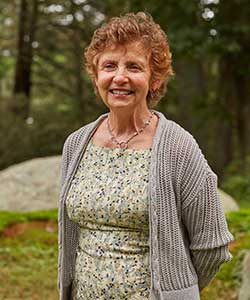
ALMA BAROZZI
By DAN TOMASELLO
LYNNFIELD — A Lynnfield educator’s love of language and world cultures inspired her to write a trilogy of books.
Village Row resident Alma Barozzi published the book “What kind of name is that? African Naming Patterns and Traditions,” last month. The book is Barozzi’s third publication in a series.
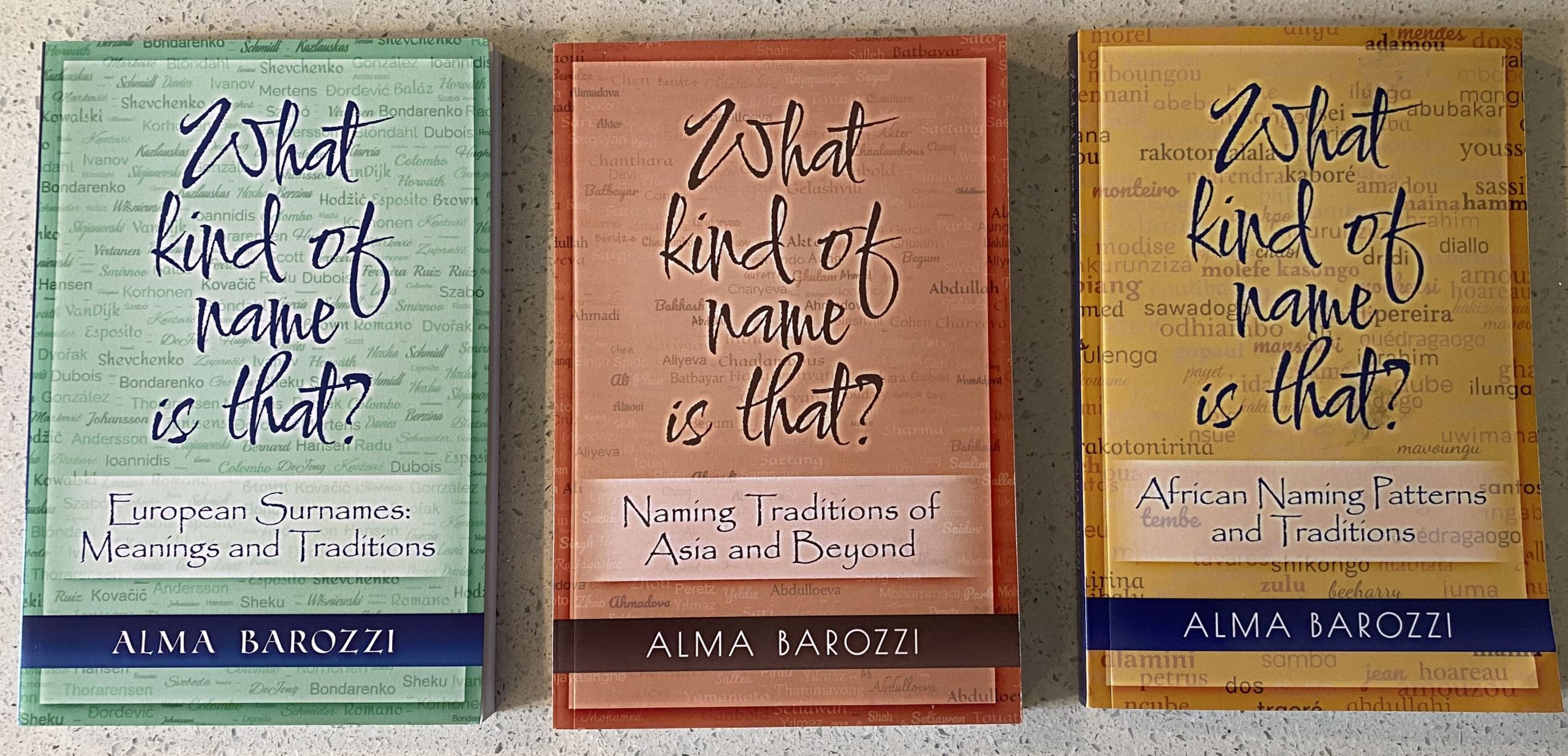
“‘What kind of name is that? African Naming Patterns and Traditions,’ published in August 2025, offers a regional and country-by-country exploration of African naming practices, highlighting the profound interplay between language, ethnicity, religion, Colonial history and cultural identity,” said Barozzi. “It would make an ideal reference book for Africana studies at institutes of higher learning.”
Barozzi published her first two books in the series in August 2022 and August 2024 respectively.
“The first book, ‘What kind of name is that? European Surnames: Meanings and Traditions,’ was published in August 2022,” said Barozzi. “It explores the evolution of surname patterns on the European continent from the dawn of inheritable family names. The book examines not only the geography and linguistic character of a people, but also the effects of its history — migration patterns, conquests, power dynamics — on national borders and cultural identities and, ultimately, on naming traditions.”
Barozzi published her second book in the series, “What kind of name is that? Naming Traditions of Asia and Beyond,” in August 2024.
“The book explores the naming traditions of more than 50 Asian countries as they reflect the languages, history, societal norms and ethno-cultural identities of this largest, most populous and most diverse continent,” said Barozzi.
Barozzi said the origins of names are completely different in Europe, Asia and Africa.
“As one moves from Europe into Asia and finally Africa, the shifting patterns of names reveal how cultures conceive of identity in different ways,” said Barozzi. “In Europe, names tend to follow a predictable order: A given name followed by a family name, a structure that has been firmly in place for centuries. Surnames are inherited and stable, often rooted in medieval occupations, geographic origins or the names of ancestors. A ‘Smith,’ ‘Müller’ or ‘Ivanov’ still carries echoes of a trade, a place or a father’s name, while Christian saints and Biblical figures continue to inspire many given names. Here, names are markers of continuity, tying individuals to long-established family lines.”
Barozzi said, “Crossing into Asia, the landscape becomes more varied.”
“In East Asia, family names come first, followed by carefully chosen given names that often express virtues, natural imagery or aspirations,” said Barozzi. “In South Asia, the picture is more complex, with names reflecting religion, caste, region and language. They may include multiple given names, patronymics and community identifiers. In the Islamic world of the Middle East and Central Asia, names are often layered with personal, religious and tribal elements. Whether influenced by Hinduism, Buddhism, Confucianism or Islam, Asian names are highly intentional, crafted to embody values and beliefs, even as Colonial legacies sometimes added new dimensions to local systems.”
Barozzi said that, “In Africa, naming becomes even more fluid and symbolic, often serving as a form of storytelling.”
“Here, a single individual may carry an indigenous name, a religious name — Muslim or Christian — and a Colonial-era surname imposed through administration and schooling,” said Barozzi. “Names are rarely arbitrary. They may record the circumstances of a child’s birth, the day of the week, the hopes of parents or the memory of an ancestor. In Ethiopia and Eritrea, fixed surnames do not exist. Instead, children inherit their father’s given name as a patronymic. Across the continent, names are living expressions of history, spirituality, and identity, balancing traditions passed down for generations with the legacies of colonialism and the pressures of the modern world.”
Barozzi’s love of language and culture inspired her to work as an educator.
“I have taught Spanish, French and English as a second language for several decades at the high school and college levels,” said Barozzi. “In the last 25 years, I’ve taught mostly Spanish, some French and a humanities course in oral history at independent secondary schools in the Boston area — at Newton Country Day School for 18 years and I worked at The Academy at Penguin Hall for seven years prior to its sudden closing in June. I taught Spanish and oral history and chaired the Foreign Language Department.”
While Barozzi has previously published academic papers and articles about linguistics, she said the trilogy are the first books she has had published.
“These books are the culmination of a journey that began in my childhood,” said Barozzi. “From an early age, I was fortunate to be exposed to different languages and cultures. My love of people, the languages they speak and the cultures they represent — combined with my interest in geography, linguistics and anthropology — naturally sparked a fascination with names, which eventually coalesced into this trilogy. At one point, I searched for a reference book on surnames and naming patterns across cultures, but couldn’t find one. So I decided to write it myself. I never imagined it would turn into three books, but one country led to another, one continent to another, and here we are. What began as a response to a simple question—‘what kind of name is that?’— grew into a deeper exploration of how we mark identity, memory and the cultural threads that connect us across time and geography.”
Barozzi said she “didn’t set out to study linguistics.”
“My first love was math, and I went to college planning to major in it,” said Barozzi. “But when I took a course in mathematical linguistics, I was fascinated. That led me to explore other classes in the linguistics department, and before long, I was hooked. I switched majors and never looked back.”
Barozzi was born in Romania and moved to the U.S. when she was 14-years-old.
“By then I had already studied or been exposed to German, Russian, French and Italian, and had lived in both Romania and Italy,” said Barozzi. “In the U.S., I was placed in an English as a second language class, where my first friends were from many different countries. I quickly picked up Spanish and became immersed in a variety of Spanish-speaking cultures. From then on, I found myself naturally drawn to people from other backgrounds. I eventually married a Colombian and lived in Colombia, where I continued my study of linguistics.”
Barozzi said the three “What kind of name is that?” books are “available on Amazon in print and digital formats.” She said that she has plans to future books.
“I can’t wait to get stated on that research,” said Barozzi.