
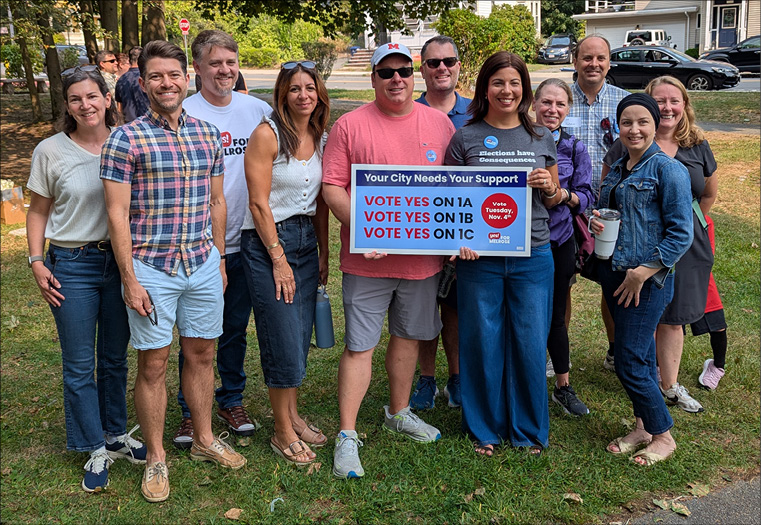
MELROSE – On a recent Saturday, a Yes for Melrose volunteer had a long conversation with a resident who is undecided about the upcoming override ballot questions. The resident understands the city’s needs, but is worried about the cost. A great conversation ensued. At the end, the two agreed on a few things: that these kinds of resident to resident chats are the best way to understand each other, and that municipal finance and local government are complicated topics. This is what the Yes for Melrose campaign is all about: conversations and connection.
There are many questions about the override, and some of the same ones keep bubbling to the top. So here are a few Frequently Asked Questions (FAQs)–and answers:
Don’t rising property values mean that the city gets more property tax money?
No, the city does not get a windfall from rising property values. By law, each year the city’s total property tax levy can only increase by 2.5% plus new growth, which is limited.The “total property tax levy” is the total amount the city can collect. Even if property values go up by an average of 5% in a year, the “total property tax levy” can still only go up by 2.5%. In fact, if the total value of all property in the City increases, the tax rate has to decrease so that the total amount of property tax collected increases by only 2.5%. For Melrose, this has actually been the case, as the residential property tax rate has steadily decreased from $11.05 in 2020 to $9.90 in 2025.
Melrose schools were fine when I was a kid. Why do we need more now?
For years, Melrose was in the middle of the pack statewide for per pupil spending, but since 2005, Melrose has consistently spent less per student than almost every other district in the state—now below the 8th percentile.
You might remember a time when Melrose had the resources it needed. Unfortunately, our investment in the city and schools hasn’t kept pace over time. Our students are paying the price.
Per-pupil spending affects everything from class size and staffing to competency in reading and math. When we underfund, we also lose support staff who help struggling students early on, which leads to higher needs (and costs) down the road. It can also mean we fail to keep pace with peer districts in course offerings, extracurriculars, and technology, and that we burn out our teachers and lose them to better-funded districts. The point is: underfunding now costs more later, and Melrose has been underfunding for years. The override isn’t about frills in the schools. It’s about funding the basics—reading support, keeping students current in STEM subjects, manageable class sizes, and the staff to meet students’ needs.
How does Melrose’s spending compare to other communities?
Across virtually every metric—school spending, city spending, and tax rates—Melrose lags behind neighboring communities, and in many cases behind state averages. These data are from the Massachusetts Department of Elementary & Secondary Education and the Massachusetts Department of Revenue, Division of Local Services.
Per-student spending
In FY2023 (the most recent year for which compiled statewide data is available), Melrose spent $16,293 per pupil. That’s 8% from the bottom statewide, and it’s 14.9% less than the average in this list of our peer communities, which average $19,147 per pupil.
• Melrose: $16,293
• Saugus: $18,564
• Reading: $19,058
• Winchester: $19,015
• Lynnfield: $19,534
• Wakefield: $20,658
• Stoneham: $20,910
City spending
When we look beyond the schools, we spend less per capita on city services than our neighboring comparable communities, as well (2025 data):
• Melrose: $3,889
• Stoneham: $4,122
• Saugus: $4,342
• Wakefield: $4,646
• Reading: $5,003
• Lynnfield: $5,681
• Winchester: $7,301
There are more questions and answers (with data sources) on the Yes for Melrose website at www.yesformelrose.org. There you can also find a ballot explainer and a tax calculator for your property. Yes for Melrose is a multi-generational, non-partisan campaign supporting a tax override to fund public resources for every Melrose resident. The campaign thanks every resident for learning more and for engaging in civil discourse on this issue.