
Another in a series of “Around Town” articles featuring Melrose residents.
Published July 5, 2019
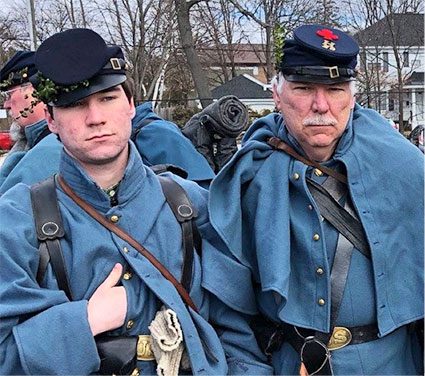
MELROSE — This July 4th week will mark the 156th anniversary of the Battle of Gettysburg (July 1 – 3, 1863). Two Melrosians, Don Lehman and his son Adam, are Civil War re-enactors who have traveled to Gettysburg and have participated in re-enactments at that hallowed ground.
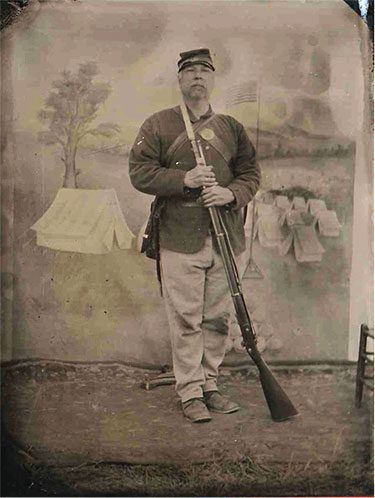
As members of the 28th Massachusetts Volunteer Infantry, 4th Regiment, Company H, Don and Adam contribute to the living history of Massachusetts’ role in the Civil War and in particular the participation of one of the Union Army’s most recognized volunteer units – “The Irish Brigade.”
The Weekly News sat down with father and son as they reflected on their participation as re-enactors, the contributions of Massachusetts and Melrose, and the enduring legacy of the Civil War.
How long have you been re-enactors and why the Civil War?
Don: Well, I got involved through Adam.
Adam: Yeah, it was kind of my idea. I got interested through school and it kind of went from there. I was really young. I started as a drummer boy. I’m old enough to carry a musket now.
Don: He was 11.
What interested you about all of that?
Adam: Just kind of like being able to live in that time period. It was very intriguing to me. The military life at that time was very interesting. That’s where I got the bug.
So how did you react when your son said he wanted to do Civil War re-enacting?
Don: Adam was interested in history. And we just followed his interest in the Civil War.
What inspired your interest ?
Adam: Well, mainly books. And some movies.
Don: And we visited Gettysburg and other battle sites several times.
Which regiment do you muster with?
Don: The 28th Massachusetts Volunteer Infantry which was part of the historic “Irish Brigade.” We went to a re-enactment they were involved with down in Connecticut and Adam was hooked. The original 28th trained on the Cambridge/Somerville line near Davis Square.
Adam: There was also another big camp up here on Rt. 1 where the Holiday Inn is. That was a big Civil War training area.
What can you tell us about the Irish Brigade?
Don: The Irish Brigade consisted of 5,000 men from five infantry regiments. In Gettysburg times it was made up primarily of several regiments from Massachusetts, New York and Pennsylvania.
Adam: What’s interesting is the North and South both had regiments made up of Irish immigrants and they fought against each other in some major battles.
Don: In the movie “Gods and Generals,” during the Battle of Fredericksburg, the Irish Brigade’s attempt to take Marye’s Heights over an open field is re-enacted. You had Irish immigrants on both sides of that fight and there was a lot of anguish. One scene in the movie depicts a Southern Irishman upset because he believes he is killing his kin.
Adam: And that really happened throughout the war.
“Gods and Generals” and “Gettysburg,” two great Civil War movies.
Don: Yes. The contributions of thousands of Civil War re-enactors, at no pay, made those films possible. They wore their own uniforms, carried their own guns. Some re-enactors portrayed soldiers from both north and south.
There’s a famous story at Gettysburg, which is in the film, where Father William Corby, a Catholic priest, blessed the troops – the Irish Brigade – before they were going into battle. That scene is quite moving as a good number of those men were going to their deaths. That last full measure of devotion.
Don: It was. And as the chaplain of the Irish Brigade he gave them absolution before going into battle.
Gettysburg is an incredible experience. What does it mean to you?
Don: I had been there before. I grew up in Pennsylvania and have at least three distant grandfathers that fought in the Civil War, in Pennsylvania units. And actually one of them fought with the 4th Pennsylvania Cavalry in Gettysburg.
And your family was on the side of the Union?
Adam: Pennsylvania was a powerhouse state in sending troops to fight for the preservation of the Union. One of our grandfathers was captured and later freed in a prisoner swap.
Don: That would be our great, great, great grandfather, Humphrey Leverknight. He was a member of the Pennsylvania 54th Infantry Regiment, Company B, when his unit was captured by the Confederates. Although, we did have a relative who fought for the South. He died in 1905, believe it or not, from his battlefield wounds.
Adam, did you know about your family’s history?
Adam: Yeah I did. I had heard stories. My paternal grandfather was a member of the Son’s of Union Veterans. So my interest in the Civil war kind of snowballed.
What should people know about Massachusetts role in the Civil War?
Adam: Massachusetts was an active state. A leading anti-slavery state.
Don: There were a lot of Massachusetts units. If you look at it proportionally to the population, Massachusetts was one of the highest. They did it to preserve the union, fight to stop slavery and for loyalty. And a lot of them joined for a job and a way for new Irish immigrants to sort of be accepted by fighting for the cause.
What can you tell us about Melrose in the Civil War?
Adam: I’ve looked into Melrose’s involvement in the Civil War. A lot of them tended to join heavy artillery regiments which were assigned to forts protecting the coast.
Don: In Wyoming Cemetery there’s a big Civil War monument and off to the side, not far away, is the grave and monument of Lieutenant Colonel Francis Hesseltine. He commanded an infantry regiment from Maine and won the Medal of Honor for bravery. After the war he moved to Melrose and became very active in civic life.
Adam: And there is a second man who moved to Melrose after the war. Lieutenant Colonel Clark B. Baldwin of the 1st Massachusetts Volunteer Infantry Regiment. He was wounded twice, including on the second day of the Battle of Gettysburg. His regiment was involved in close fighting and they had severe losses, nearly 70 percent. His remains are also interred at Wyoming Cemetery.
So what take away do have from being so close to the history of the Civil war?
Adam: For me, beyond the obvious issues of preserving the union and ending slavery, is how Americans viewed themselves. Before the war you were a New Yorker or Virginian who happened to be from America. And in many instances you signed up or were drafted representing your own state. After the war people generally thought of themselves as Americans who happened to be from their state. Some in the North came to that realization sooner than others. But today, that’s generally how most people see themselves and that started with the end of the Civil war.
Adam, you’re off to college this fall. Do you see yourself continuing with the Civil War re-enacting?
Adam: I hope so. I do enjoy it. The simulated re-enactments, the thrill and the equipment of the day all appeal to me.
Any thoughts on the food Civil War soldiers ate?
Adam: Lot’s of beans, salted meats, hardtack (biscuits). Coffee. Not a great diet.
Don: There’s a company in Milton that still makes the Civil War hardtack that soldiers ate. The Bent Cookie Company has been baking hardtack since the early 1800’s and they’re still at it.