
By EVA HANEGRAAFF
NORTH READING — High standardized tests scores and extensive honor rolls are not the only way North Reading High School students prove their impressive academic prowess.
Through competition against other schools, North Reading students demonstrate their ability to take tests, write essays, deliver speeches, and participate in interviews all on a single subject matter for which they spend months studying and preparing.
The high school’s Academic Decathlon allows students to gain the opportunity to build skills with real world application as well as study a topic that they may have otherwise not known much about. Club officer and four-year member, Raffi Toby, explains, “Each year, Academic Decathlon, the national organization, chooses a theme for the year, and this year, it is the changing climate.”
For the competitions, teams of six to seven compete, with each team member participating in every aspect of the competition. Each of the 10 events are out of 1,000 points, for a total score for an individual participant being out of 10,000. Seven of the events are tests in subjects such as math, literature, social science, economics, music, art, and science. The last three events are the subjective events in which competitors have to deliver a speech, write an essay, and do an interview. Teams are ranked by the sum of each individual’s scores. Toby expresses, “everyone’s part of a team which is what makes it fun.”
Academic Decathlon competes three times a year. Their first competition was held in November, and participants only compete in the subject tests as this competition, not the subjective events. “The November competition every year is friendly where teams just get the experience of taking the test and what a competition will be like,” Toby said. Their next two competitions take place in February and March, and both include all 10 events.
For their November competition, the Academic Decathlon team took a van at around 7 a.m. to Springfield High School in which they competed against many other schools. Upon arrival, they were sent to a room with about 20 other students to take the tests. After all the tests had been completed, the students then had lunch and waited for the awards that were given out to the three highest scores in each category.
“It’s a lot of fun,” Toby says, “we get to hang out with each other in between and eat food and play games, so it’s a fun experience.”
For scoring, the subject tests are around 50 questions, and based on the number answered correctly, each student is given a score out of 1,000. “The exams are designed to be really difficult because the biggest skill you can have in Academic Decathlon is the ability to study and learn information quickly,” Toby explains. For the subjective events, they are all graded on a rubric, with confidence and demeanor also playing a role in the speech and interview grades.
The resources that the participants are given to study are extensive and thus, they have to prioritize what to study and focus on. “You have to pick and choose what’s more important so it’s typical for a lot of people to get in the three and four hundreds out of a thousand, which doesn’t sound very good until you’ve taken one of these tests and see how difficult it is,” Toby said.
The club has meetings every Wednesday morning for about 40 minutes before school. These meetings consist of the club watching a slideshow created by one of the club’s teacher advisors that includes information to prepare them for one aspect of the upcoming competition using resources that are published by the Academic Decathlon organization.
Another way they need to prepare for the competition is through writing the essay during a timed block during one of their meetings to submit online prior to the competition.
Beyond the competitive aspect of the club, Academic Decathlon has a positive impact on students in their daily lives as well. “It has definitely helped me become a better test taker,” Toby says. “There’s a lot of times you spend a test mostly guessing, but, when you’ve taken a lot of these tests you can figure out how the questions are designed and you can make better guesses.” He adds, “Participating in the speech has made me become a better public speaker and the interview is also a very good skill to have.”
Although Toby remarks on his incredibly positive experience within the club, the numbers of members tend to be less than that of many other competitive organizations around NRHS. Toby says, “People tend to think you have to be really smart or have a high GPA, but actually it’s the exact opposite.” Academic Decathlon is split into three divisions by your GPA. Students with GPAs of 3.8 or higher are placed in the honors division; those with GPAs slightly below that are assigned to the scholastic division, and the remaining students are assigned to the varsity division.
Because team scores are made up of the team’s highest two scores in each division, a greater spread of GPAs actually significantly benefits the team overall. “An issue we’ve had is that we’re really good in the honors and scholastic division because those are the people who tend to join the club, but we’re missing one if not two people to compete in the varsity division,” Toby said.
In an attempt to solve this problem Toby adds, “We are always encouraging people to join, even if you don’t do well in school. There’s no reason not to do it because you’re actually contributing heavily to the club.”
However, Toby does understand why some other students may be apprehensive. “It’s kind of hard to get people to join a club where they take tests and write essays,” Toby admits. Still, he believes it could be a positive experience for for all students. “I think people who give it a shot realize it’s really low pressure and you get to learn some cool stuff,” he said.
Beyond competitions, the club also engages in a fundraiser every year selling candy around school. This largely anticipated fundraiser as well as bake sales is how the club funds their study materials and competition snacks.
For Toby, the low pressure and educational experience of being in Academic Decathlon has left a lasting impact that he will carry to college next year and into his professional life.
Regional competition update
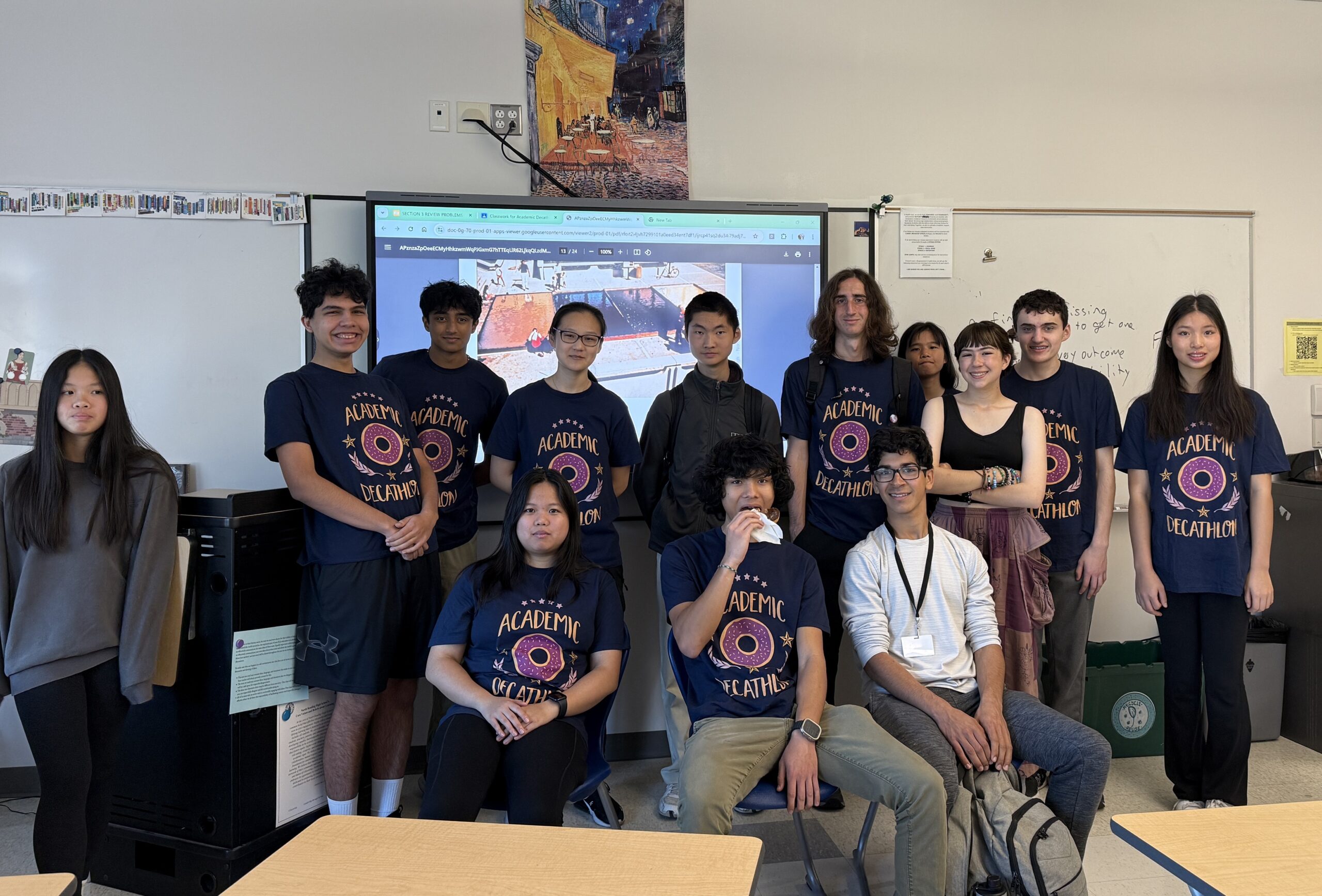
On Saturday, February 1, the Academic Decathlon team traveled to Ashland for the Regional competition. Competitors were Aakash Stewart, Naveen Stewart, Katherine Zhu, Norah Deninger and Sameer Murthy (main team) plus Xin Ling Chen and Kevin Gu (alternates).
In the honors division, Aakash Stewart finished fourth overall, bringing home gold in Science, bronze in both Math and Social Science, and fourth in both Economics and Literature. Also competing in the honors division was Naveen Stewart who won silver in Social Science and fourth in Math, Science, and Literature. Additionally, Katherine Zhu scored fourth in both Science and Literature in the honors division.
In the scholastic division, Norah Deninger finished with a bronze medal overall by scoring gold in Music, Literature and Essay, bronze in Social Science, and fourth in both Science and Interview.
In the varsity division, Sameer Murthy won silver in the subjective events, and bronze overall with gold in both Music and Interview, and silver in Economics, Social Science, and Speech.
The team now moves on to the State competition, to be held at M.I.T. on Saturday, March 1.