
By NEIL ZOLOT
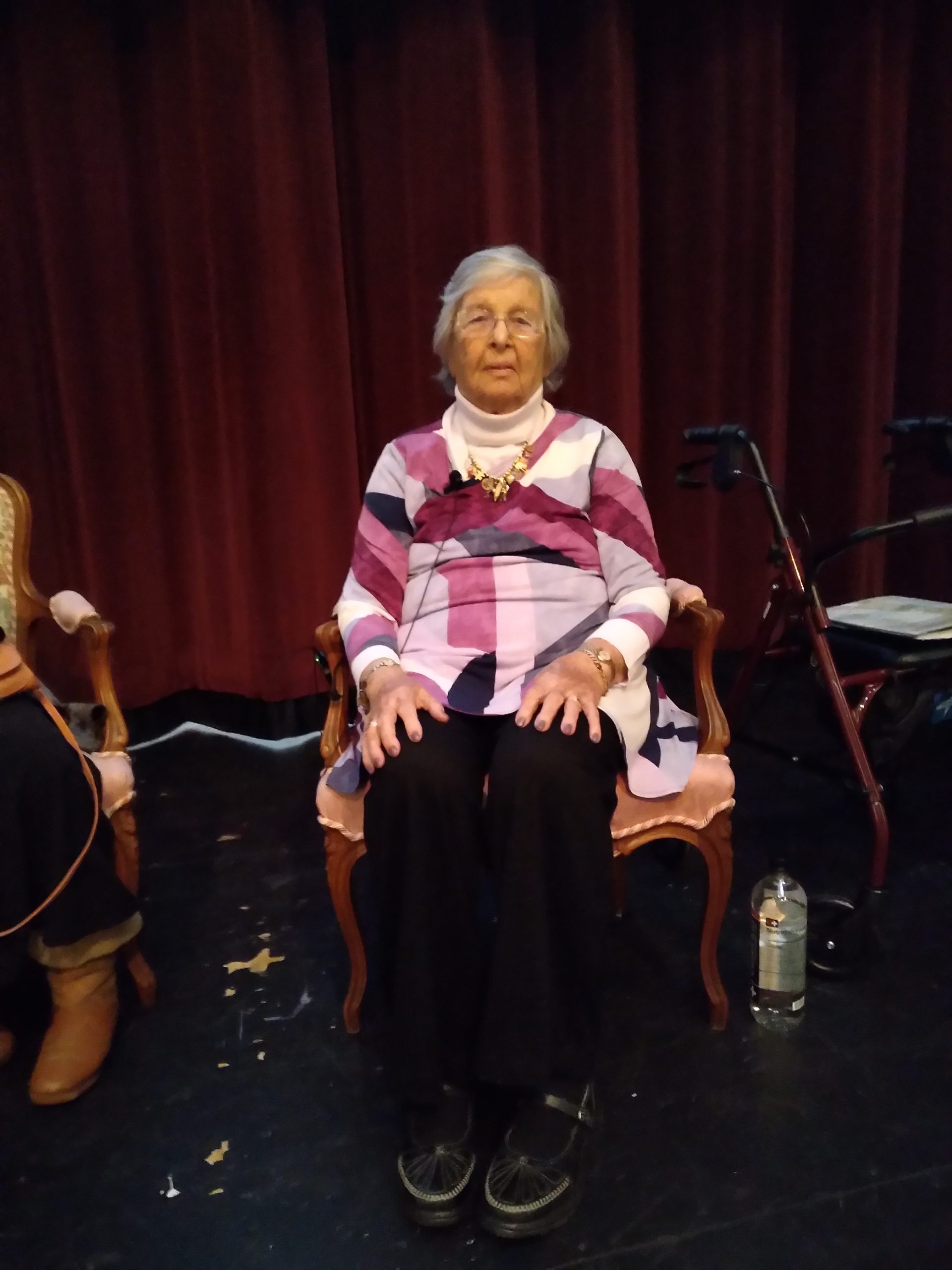
READING — The 900-seat Reading Memorial High School auditorium was only a few seats short of being sold out for a one-night appearance by 97-year-old Holocaust survivor Helga Melmed earlier this month.
“Let’s not forget one of the worst things that happened in history,” Melmed said in her speech about the dangers of hatred and bigotry. “I hope people will create a better world, but remember the hard times hate brought to the world.”
Melmed’s appearance was sponsored by Chabad of Wakefield. “Education is the strongest weapon against hate, but history has shown us the battle is never over,” Rabbi Sruly Brook said in his opening remarks.
Even with amplification, Melmed’s voice was soft, but the 850-plus people in attendance remained remarkably quiet and still to hear her.
Her testimonial was a series of devastatingly poignant memories ranging from early encounters with anti-Semitism as a young child to her eventual liberation from a concentration camp and relocation to the United States as a young woman.
She was born in 1928 in Berlin and as early as 1934 was beaten on the hands with a ruler by a teacher and insulted by other children. “People hated Jews because we were different,” Melmed said. “Were we so different? I don’t think so. I asked my mother why, but it was difficult to explain to a 5 year old.”
She and other Jewish children were transferred to private Jewish schools. “I loved it,” she said, but life eventually became difficult for Jews due to laws restricting their movements.
Melmed was 10 during Kristallnacht, the Night of Shattered Glass, when Jewish institutions were ransacked in 1938. “I realized evil was going on,” she said. “Soldiers were burning my school.” Jewish schools were closed, but education continued in informal classes.
In 1941 her family was involuntarily relocated to a ghetto in Poland, via cattle car. She recalls her mother telling her to put on layers of clothes so she would have them to wear later.
She also witnessed people being killed and hung on meat hooks in a slaughterhouse while waiting to be transported. “It was a horrible sight for a child to witness,” she said. “I was 13.”
Her father was put to work in manual labor and she and her mother were put to work sewing clothes and buttons. Her father was shot by German soldiers using prisoners for target practice and her mother gave her what little food they had to begin with. “We had very little, but what she had she didn’t eat,” Melmed said. “She told me to eat. At the time, I didn’t realize she was sacrificing her food for my life.” Her mother died on Melmed’s 14th birthday.
By 1943, Russian troops came to Poland and Melmed was moved to Auschwitz with a group of other children she had become close to. “It was a terrible place,” she said. “We knew what was going on and were scared all the time. We were close to the gas chamber and could see black smoke and smell burning flesh.”
Humiliating experiences included having her hair shaved off and being made to stand naked before soldiers, but another time she and others were taken to what she thought was a gas chamber, but was a shower. “We thought we were going to die, but we didn’t,” she said.
People at Auschwitz heard bombing in the area, but the camp was not hit. “We always had hope,” Melmed recalled. “We kept hoping for better days to come, but better days did not come.”
In 1945, she was moved in a “death march” to the Bergen-Belsen camp. “Many people died on the way or were shot,” she said. “If you ran away they would shoot you or if you fell they would shoot you.”
Her friends were scattered, although Anne Frank was there at the time. “My heart ached for my friends,” she recalls. “I didn’t see them for many years until after the war.”
At 17, Melmed was suffering from typhus when Allies liberated the camps and she was taken to Sweden and nursed back to health from a low weight of 46 pounds, a comment that elicited gasps from the audience.
“I was treated well and recovered,” she said.
She also learned Swedish and was adopted by a German man who had fled to Sweden before World War II.
In one of many episodes of reuniting families, an aunt in New York located her and she came to this country by boat. “We saw the Statue of Liberty,” she said. “It was beautiful.”
Her studies resumed, this time in English. She translated English lessons to German and back to English as a way to learn.
She graduated high school, studied to be a nurse and became a nurse at a Jewish hospital in New Jersey in 1951. It was too far to go back to New York regularly, but she often went to see her roommate’s family in New Jersey, where she met her roommate’s brother. “He had a girlfriend, but never mind the girlfriend,” she joked. “He liked me.”
They were married for 65 years and had four children. She now has four grandchildren and is hoping for great grandchildren.
Today, Melmed lives in Florida. “I hope people will create a better world,” she concluded. “People should know what hate and prejudice can do.”
Rabbi Brook said Melmed’s “very presence is a testament to survival and strength.”
He told her “your courage reminds us we should never forget. Words cannot express our gratitude.”
He also called the event “successful beyond words. The size of the audience is an indication of people’s commitment to fight hate.”
Brook is also urging people to “fight darkness with light, hatred with action and lies with truth. Acts of kindness are the way to fight hate.”
State Sen. Jason Lewis was among the people attending. He called Melmed’s appearance “incredibly moving” and “a rare opportunity to hear from a Holocaust survivor first hand.”
He also said various acts by the state legislature mandating education about genocide and the Holocaust in middle and high schools were passed after it was found that more than half of students did not know about the Holocaust and other genocides. “We think it’s something everyone knows about, but not everyone does, particularly young people,” he said. “If we want to make sure history doesn’t repeat itself, we have to educate young people.”
Editor’s note: Reporter Neil Zolot regularly covers the School Committee and writes occasional feature stories for the North Reading Transcript.