
By NANCY BERTRAND
Wakefield’s Old Burying Ground is like an outdoor museum, filled with ‘artifacts’ reaching back to the town’s beginnings. Visitors can find the truest testament to those brave pioneers who first settled here, and their only monuments left standing.
In one way or another, the Old Burying Ground tells stories of those early settlers — their joys as well as their sorrows; their lives as well as their deaths. Through studies of the files of the Wakefield Historical Society and the Wakefield Historical Commission, it was possible to ‘resurrect’ some of their stories and, with the help of the Wakefield Item, to share them.
It might surprise people in town to learn that Wakefield is the home to some of the most treasured examples of Puritan Gravestone Art in New England, and that researchers come from all over to view and photograph them.
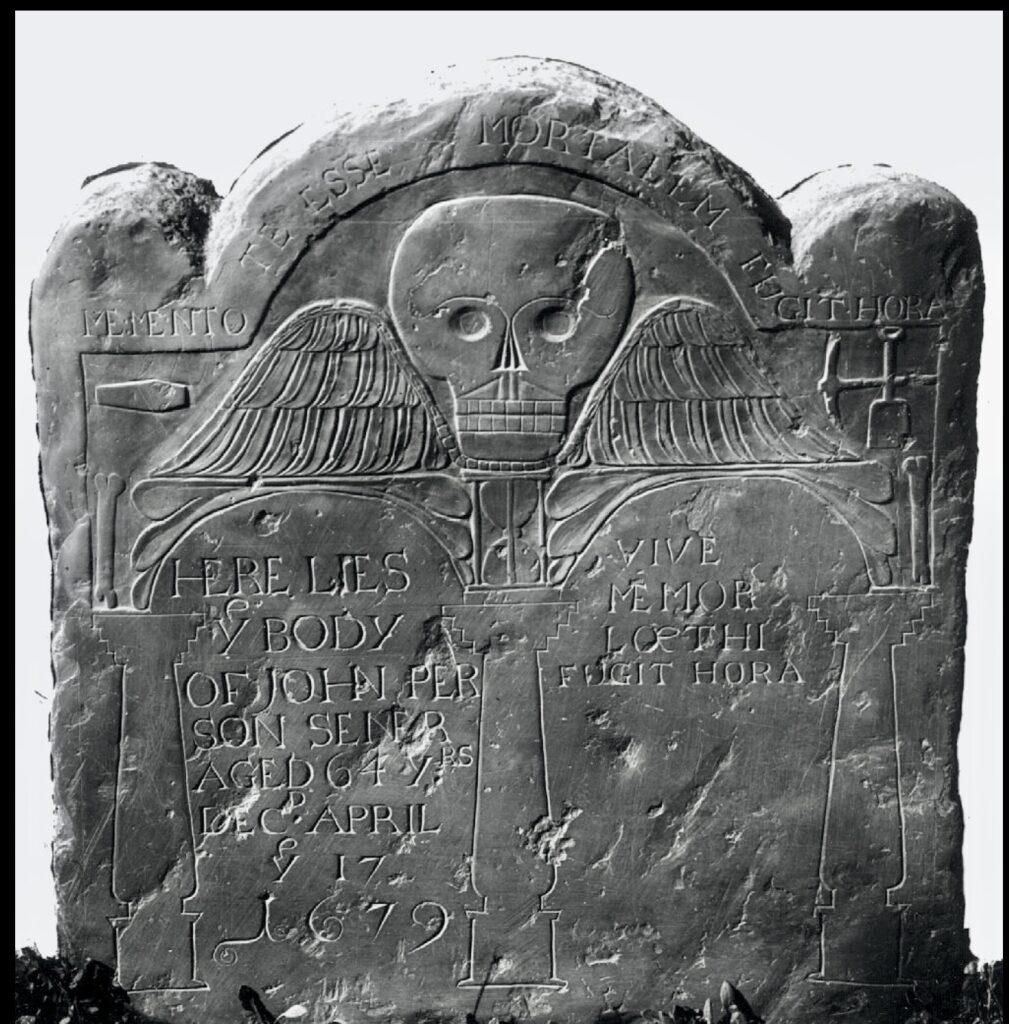
The town’s oldest marker is that of John Pearson (spelled “PERSON” on the gravestone.) He was one of the town’s first settlers in the 1640s, and one of the seven founders of the First Parish Church.
John was a tailor by trade and he owned enough land to be considered yeoman or freeholder. He died on April 17th, 1679; 11 years later his wife Maudlin would die in 1690. Though his family would move to what is now Lynnfield in 1689, Maudlin was presumably buried beside him when she passed. Sadly we will never know, since, like many of our oldest settlers, no gravestone survived for her. In fact, it’s rather amazing that John Person’s gravestone survives, but his body is buried somewhere on what is now Wakefield Common, which was the actual first Burying Ground for the town. His gravestone can now be found in a long continuous line at the extreme western edge of the Old Burying Ground, in what was originally the Town Pound. The Historical Commission has erected a marker nearby to alert visitors seeking the old stones.
His gravestone is a beautiful example of the magnificent carving and beautiful symbolism on the old slate gravestones.
As you think of those old gravestones remember that John Person, like most of these early settlers, was a Puritan, for whom the representation of the spiritual in art of any kind was strictly forbidden. (You would not even find a cross in a Puritan household.) So the winged skull, representing the death of the body but the everlasting soul, would have been a taboo. In looking at the gravestone, we can enjoy the beautiful carving and the delicate wings; the images of death in the coffin and pick and shovel and bones. We really do marvel at the age of the stone. The oldest stone in Boston is in King’s Chapel, dated 1658 (William Paddy — only words remain). This one is so beautiful…. But it is, for sure, an acquired taste!
Another ‘gravestone story’ will be told tomorrow, and through the month.
The stories will also continue on the Historical Society’s facebook page, and on wakefieldhistory.org.