
Wakefield’s Old Burying Ground is like an outdoor museum, filled with ‘artifacts’ reaching back to the town’s beginnings. Visitors can find the truest testament to those brave pioneers who first settled here, and their only monuments left standing.
In one way or another, the Old Burying Ground tells stories of those early settlers — their joys as well as their sorrows; their lives as well as their deaths. Through studies of the files of the Wakefield Historical Society and the Wakefield Historical Commission, it was possible to ‘resurrect’ some of their stories and, with the help of the Wakefield Item, to share them.
By NANCY BERTRAND
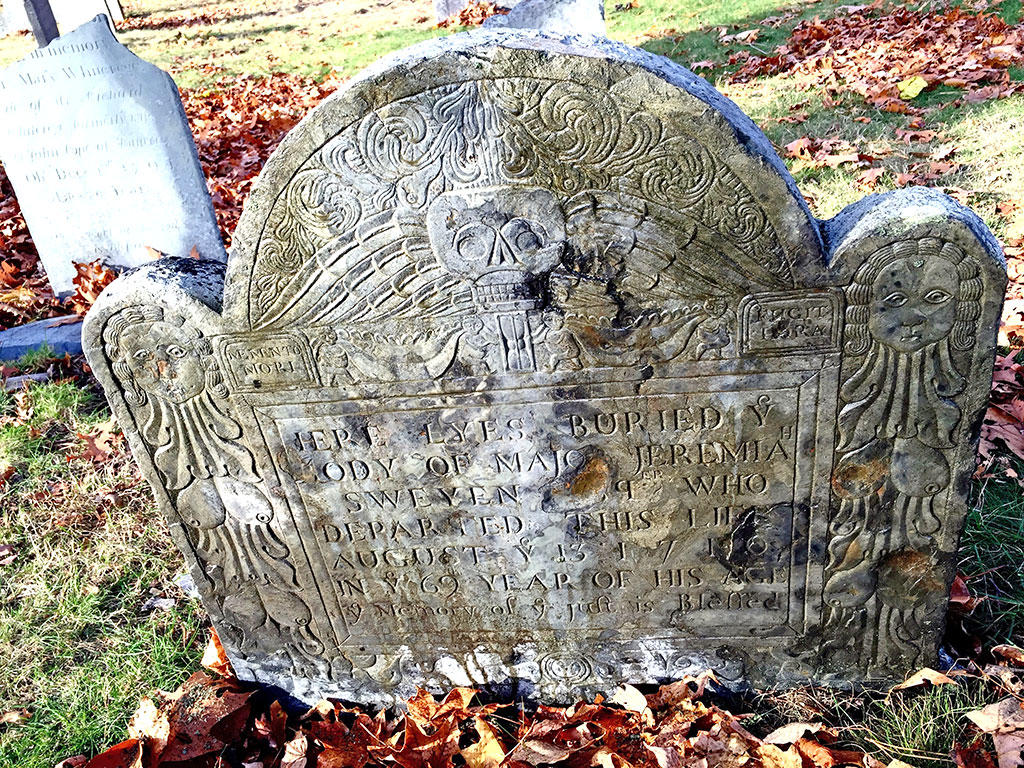
For today, the 15th day of October, we visit a gravestone high on the brow of the hill toward the fence near the parking lot of the First Parish Church. Here, in its original location, lie the remains of Captain Jeremiah Swain (or Sweyen). Captain Swain was the son and namesake of a very early settler who was in Charlestown in 1638 and received 12 acres of a Meadow Grant. The first family home was on the old road to Salem in today’s Montrose section. Jeremiah Sweyen, both father and son, were physicians, as were other descendants.
Major Sweyen, born in 1643, married Mary Smith, the daughter of First Settler Francis Smith, who was coincidentally related to another military notable of this town, John Hart, whom we will visit next week. Jeremiah would become Selectman, and afterward Representative to the General Court, assistant to the Governor and Captain of the town’s company.
A footnote to his military service came when he initially ran against Captain Jonathan Poole to command the town’s regiment. Captain Poole, older and more experienced, had the vote of the town’s institutionalists; the dashing doctor Jeremiah Swain had the vote of the younger crowd. After the vote, a somewhat bitter letter was sent to the General Court complaining about some anomalies in the voting procedure.
Nevertheless, on the field of battle Swain showed his mettle. In the Great Swamp Fight of King Philip’s War, he was a lieutenant in the 1st Middlesex under Major Appleton. On a bitterly cold daybreak in late December 1675 the troops began a 16-mile hike in a heavy snowstorm, reaching the opponent’s fort at 2 p.m. After fasting during the hike, facing fierce fire and heavy losses, they eventually forced the opposing force out of their fort and into the swamp and woods, while the Massachusetts men set the fort alight. Turning back, that same day, the force, carrying more than 200 dead and wounded, marched 16 miles back. Seven captains died that day. Among the many wounded was our Jeremiah Swain.
Two years later, he led a company of 50 men and 10 Native Americans from Richmond Island up the Kennebec River to Saco to relieve settlers from Dover and Wells. Two years after that he was given command of 7 Massachusetts companies and others from Plymouth, to try to clear the border towns as far as Portland.
After this service, he became Justice of the Peace for Reading in 1691; we hear his voice in court when he questions a defendant accused by his sister Mary Marshall in the 1692 Witchcraft Trials.
Major Swain died in 1710, a brave and successful man of high stature and great military service, who served as a physician throughout his life.
His gravestone shows the ravages of time. Likely carved by the shop of Joseph Lamson and sons, the carving shows much for elaboration at the top, but the carving is not deep and has eroded somewhat. Lying under a tree, the stone would prove hard to photograph but also is possibly endangered by falling branches in the event of future storms.
Join us tomorrow for the next installment in our October series of Graveyard Tales, as we search among the fallen leaves for the stories of the people who built this town.
Still to come: a Revolutionary War general and surgeon, a ghost story, some further allusions to victims of this town’s witchcraft hysteria and delusion, and the gravestone that is widely considered to be the epitome of Puritan Gravestone Art throughout the nation.