
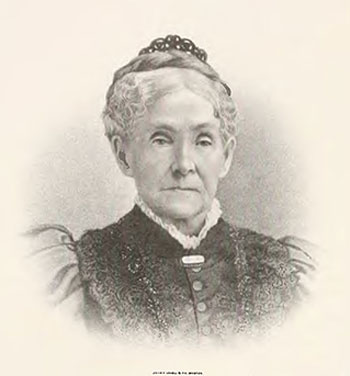
This is the first of a series. It was submitted by Nancy Bertrand.
Harriet Evans grew up steps away from the Common. Born in 1815, she was one of nine children who called South Reading home and were proud that one of her ancestors had first come to what is now Greenwood in 1680. Her father Thomas ran a general store on what is now Salem Street , advertised as “third house from Main,” where he sold all manner of things, but was starting to specialize in shoes.
Thomas and his wife Phoebe (Cummings) from Woburn were patriotic people — three of their sons were named James Madison, Thomas Jefferson, George Washington — and brought their children up to revere their town and their nation.
The kids attended the old schoolhouse then standing upon the Upper Common. Their daughter Harriet discovered that she loved teaching. She took a job as a teacher in North Reading Public Schools and, in 1840, married a family acquaintance who was also from among the first settlers to the area, Charles Flint. Charles, a determined and ambitious man, had descended from a family renowned for military service in the earliest days of the country, was hard working and industrious —he was also ambitious. When he heard that the Salem and Lowell Railway was being laid out, he became an investor — and then a director — and then the president of the company. His fortune made, he also became of the directors of the Wamesit Bank of Lowell. One day, during a business trip to Salem, Charles took a fall, striking his head and eventually dying of a brain injury.
Harriet Newell Flint, a childless widow after 28 years of marriage, was alone. She had inherited a significant fortune, and everyone expected her to hire a manager or sell her stocks and retire. At fifty-three, she had never before played a public part in the administration of her husband’s business or financial affairs. But Harriet was no quitter. After studying the situation, Harriet revealed a keen insight into business, along with an energetic mind and great determination. She would more than double her husband’s extensive estate. Perhaps she asked for help from one of her many brothers — her little brother Lucius Bolles Evans had raised up a thriving company himself. Or maybe she gave him advice — there was no stopping the determined Mrs. Flint.
The Flints had originally lived in North Reading but upon her husband’s death, Harriet decided to move back to her childhood home. In his lifetime, Charles Flint had purchased an estate overlooking Crystal Lake. Harriet made this her home, laying out a street across her homestead and naming it ‘Charles Street’ in her husband’s honor. The estate consisted of 24 acres, including the picturesque elevation known as ‘Hart’s Hill.’
From this home, Harriet administered not only her business interests, but also her charities. She turned her attention first to the town of North Reading and began to carefully choose projects to support. Charles, who had never achieved more than a common school education, had a reverence for higher learning. In his will, he had left the sum of $1000 to North Reading public schools for medals of excellence. The execution of this gift proved impractical, so Harriet turned this bequest into the nucleus of a grant to form a public library. To this gift, she soon added an additional $2000, and then, in 1875, the gift of the structure known as the Flint Memorial Hall, where the town’s library and public offices were located. She also contributed to churches in North Reading that were struggling, and made donations to keep the roadways in good repair.
Soon after, she turned her attention to Wakefield, making a donation to the Beebe Memorial Library, and supporting the public schools, the police and fire departments, disabled Civil War veterans and their families and churches and charitable institutions. She was interested in public works projects, made donations to support roadways and to provide public drinking fountains. She also supported the creation of the “Wakefield Home for Aged Woman,” later called the Boit Home.
Upon her death in 1895, Mrs. Flint’s will would continue her charitable work with donations in the amount of over $100,000 to a variety of worthy causes. The one cherished goal that she did not achieve, due to the suddenness of her final illness, was her intent to bequeath her home and the land now known as “Hart’s Hill” to the Massachusetts Metropolitan Park Commission, for use as a public park.
Mrs. Flint is best known in Wakefield for her bequest of the sum of $10,000 for the purpose of erecting a monument to the memory of the Soldiers and Sailors who had taken part in the Civil War. Mrs. Flint had long been a supporter of veterans’ causes, and had donated the furnishings for the War Memorial Room in the old Town Hall. Her donation for a monument specified that the “monument … be grand in itself, symmetrical in architecture, beautiful in design and finish, attended with solid and thorough workmanship, worthy of the brave men to whom we dedicate it.”
When the monument was dedicated in 1902, Harriet’s nephew Harvey Evans, then president of L.B. Evans’ Sons, remarked upon his aunt’s memory, noting her intense patriotism and the fact that all of the flags in evidence would have pleased her. “She loved flags,” he said, and decorated her house with them. “Her pride and joy,” he said, was the success of our nation. She lived a “vigorous life — you might even call it strenuous” and exercised the Yankee frugality that helped her save her money so she could give it away to worthy causes.
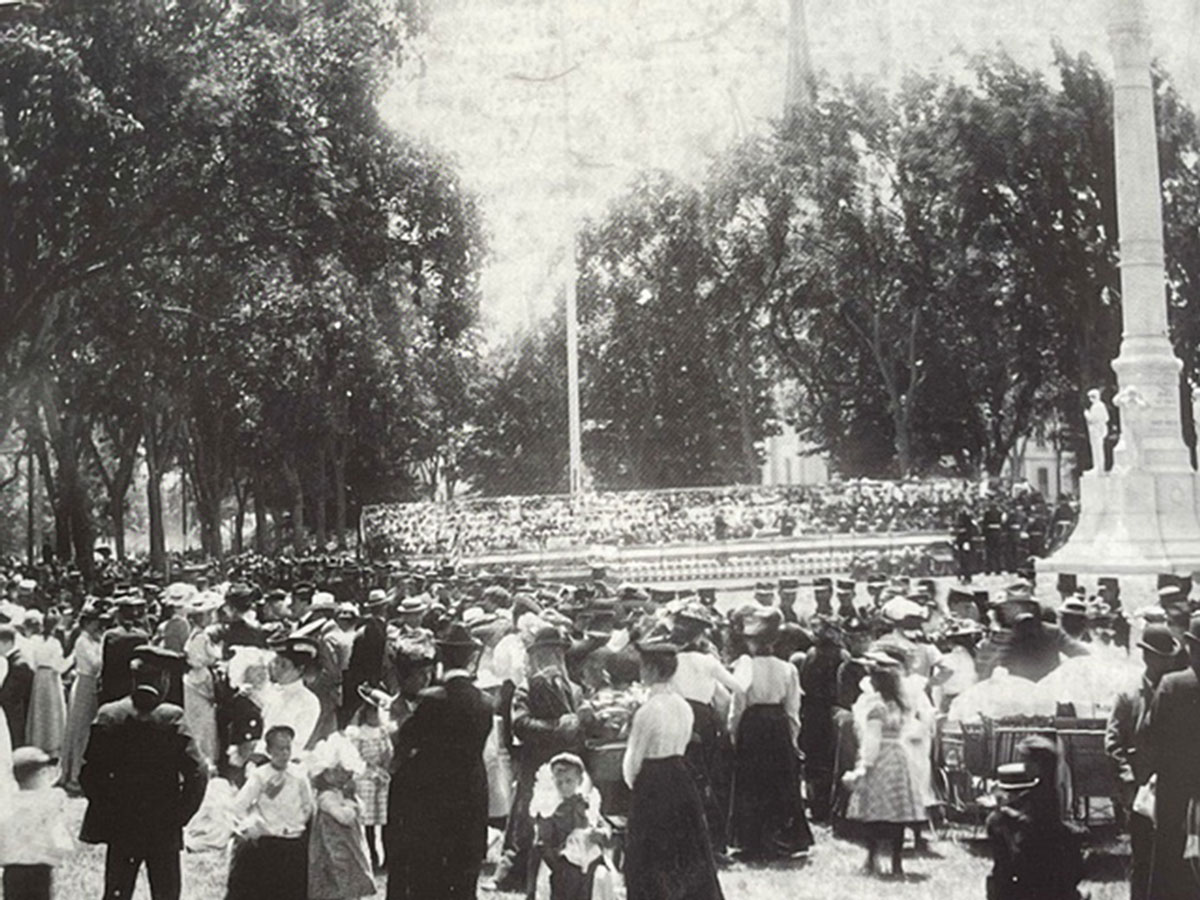
On May 31st of this year, the town will hold a grand rededication ceremony for the Monument that Harriet had gifted the town, which was built coincidentally near the site of the first public school that she had attended and steps away from the house where she was born and raised. Harriet Newell Flint had loved the land of her birth, and had delighted in giving back to it. The resulting Soldiers and Sailors Monument on the Upper Common, originally dedicated in 1902 and new beautifully restored by the Town, is a testament to the generosity of this fine woman. How happy she would be to see the Common filled with flags and people coming together to honor the brave men who had served and died in the Civil War!
This biography is part of the Wakefield Historical Society’s “Women in Wakefield” series. The series will celebrate Women’s History Month with a new story every day of a woman who helped to shape our town. The stories will be published online at the Historical Society’s website wakefieldhistory.org, and also on the Society’s Facebook page.