
By MARK SARDELLA
WAKEFIELD — The Zoning Board of Appeals has ruled in favor of the Permanent Building Committee (PBC) in the latter’s appeal of a decision by the Building Inspector related to the new Wakefield Memorial High School building project.
Attorney Brian McGrail represented the PBC/high school project at the recent hearing on the appeal of a decision made by the Building Inspector. (Last June, the Town Council appointed McGrail as a “special municipal employee” to represent the high school building project with respect to any zoning issues. The designation means that McGrail can represent the town pro bono before a town board like the ZBA, without losing the ability to continue representing private clients.)
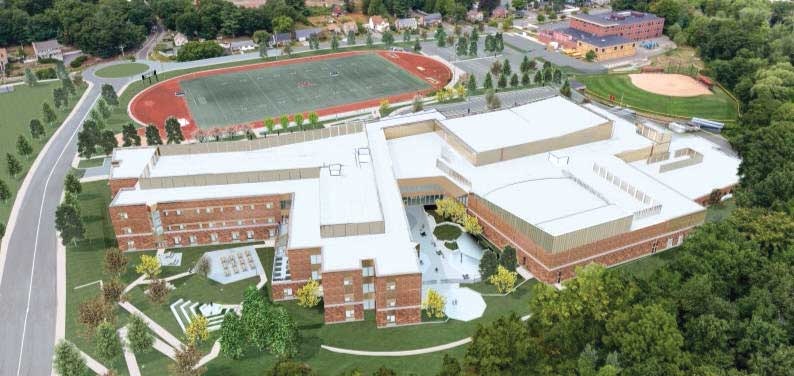
After a brief overview of the building project by civil engineer Erin Prestileo and architect Tom Faust of project designer SMMA, McGrail reminded the board that the project falls under MGL Chapter 40A section 3 (also known as the “Dover Amendment”).
The Dover Amendment provides that no zoning bylaw may prohibit or require a Special Permit for the uses of land or structures by educational uses or the expansion of existing structures, for the primary, accessory, or incidental purposes of operating an educational facility, provided, however, that the project may be subject to reasonable conditions regarding bulk and height of structures, yard sizes, lot area, setbacks, open space, parking and building coverage requirements.
McGrail also cited Section Chapter 190-34.A of the Wakefield Zoning Bylaw, which states that the dimensional regulations applicable to every lot of land in the Municipal District (which the high school is) shall be the same as the surrounding district.
But when a lot of land in the Municipal District is adjacent to two or more zoning districts (as the high school is), then the dimensional regulations applicable shall be the same as those of the least-restrictive adjacent zoning district.
The high school site, McGrail explained, is adjacent to both the Single Residence and Business districts, so the applicable regulations are those of the Business District, the least restrictive of the two.
Still, the project does not meet the regulations in several respects.
“It is my position that many of the dimensional and parking requirements under the Bylaw including, but not limited to the sections to be presented, are unreasonable when applied to the new Wakefield Memorial High School,” McGrail said.
Under the Dover Amendment, only “reasonable” restrictions are allowed to be placed on school projects.
McGrail explained that he filed with the Building Inspector and pointed out the deficiencies under the Zoning Bylaw. Building Inspector Benjamin DeChristoforo decided to issue what is known as a “friendly denial” in order to allow the issues to be appealed to the ZBA.
McGrail listed the following areas where the high school project would not be in compliance with the Zoning Bylaw.
1. Section 190-31C.1 that prohibits parking in the front yard;
2. Section 190-31C.1 that prohibits driveways from exceeding 20 feet in width;
3. Section 190-31K regarding lot shape;
4. Section 190-37E.1 requiring that surfaced areas of off-street parking shall be set back a minimum of 7.5 feet from all building and that open parking areas hall be separated from the street line by a landscaped strip not less than 15 feet in width;
5. Section 190-37E.2 requiring that at least 5 percent of the interior of parking lots with 40 or more parking spaces shall be landscaped;
6. Section 190-37I.1 requiring that driveway may not exceed 30 feet in width at the street line and shall not be spaced closer than 100 feet to another driveway serving the same lot.
McGrail reiterated that the Dover Amendment allows only “reasonable” restrictions on school projects. He went through each issue of noncompliance and explained in each case why he believed it would be unreasonable to expect the high school project to comply.
In the end, the Zoning Board of Appeals agreed with McGrail and overturned the Building Inspector’s denial by a vote of 5-0, meaning that the high school project will not be required to comply with the above listed sections of the Zoning Bylaw.