
Wakefield schools’ retired music specialist talks about career, life
Published in the August 23, 2018 edition
By GAIL LOWE
WAKEFIELD — Hair stylist Tania Gerrior Alongi smiled broadly when a client asked if she remembered James Rizza, retired music specialist for Wakefield’s elementary schools.
“Mr. Rizza?” Alongi said. “I absolutely do remember him. He made me sing ‘You Light Up My Life.’ He lit up my life, that’s for sure.”
And he did the same for thousands of other students who grew up in Wakefield under his tutelage.
Said Andrew McRae of Wakefield: “Mr. Rizza was everyone’s favorite when we were in elementary school. We looked forward to his weekly visit to our classrooms at the Lincoln School, as it not only provided a break from the daily routine, but his enthusiasm and love of teaching was infectious. To this day, many of us still remember the variety of music and songs he introduced to us. Plus, he was, and still is, an all-around nice guy.”
During his 33 years of employment in the town’s School Department, Rizza taught students how to enunciate, project and stay on key and in tempo while singing in his classes. The grand master of music has also taught countless people of all ages inside and outside of Wakefield how to play piano.
Locally, there’s Concetto “Chuck” Ferrara and Katrina Faulstich and a bit farther away Joe Rindone of Methuen. Rindone studies with Rizza and also tunes both of his pianos. Both? Yes. Rizza has a pair of Steinway baby grands in his piano studio that sit face to face. One is Rizza’s private piano. The other is used by his students.
A writer from the Daily Item recently called Rizza to ask if he would be willing to be interviewed. A humble man through and through, he shied away from the idea at first. Then, he took up the matter with one of his students. She said: “Why not, Jim? You have a story to tell. Would you rather see it in print now and be able to read it or have it published in your obituary when you’re no longer here to enjoy it?”
That settled the debate. He consented to the interview, and he and the Daily Item writer met at his home to talk about his life and music career.
After entering a door next to his garage on Water Street, the Daily Item writer found several other doorways that led to his piano studio at the rear of the house. She noticed that the musical décor on display along the way offered proof that music is of paramount importance: A G clef door knocker, musical quotes written on small plaques, busts and prints of famous classical music composers and a framed drawing of Uncle Sam pointing his finger. “I want you — to practice every day!” it said.
Classical music has always been Rizza’s calling. No jazz or Broadway tunes for him. Only the best of the best will do, including Chopin, his top favorite; followed by Mozart, Liszt, Debussy, Bach, Beethoven, Schubert and so many more.
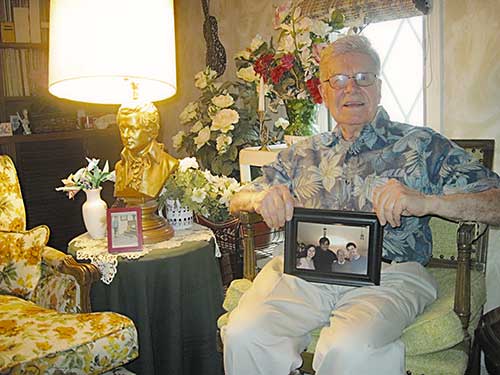
The interior of the piano studio was softly lit and was conducive to a relaxing musical experience. In some respects, it was like a friendly museum. Musical displays were all around, including a lamp whose base is a bust of Mozart and several mobiles hanging from the ceiling. Every memento, from the hallways to the piano studio, had been a gift from students past and present. There were also newspaper clippings concerning his students when stories about them had been published in the Daily Item.
For instance, Rizza showed the writer an article about Jessica Means, one of his former students. She graduated from Wakefield Memorial High School and was valedictorian of her class. Rizza proudly stated that she continued her education at Harvard and Columbia universities and is now a surgeon in Boston.
“You wrote this article about Jessica,” he said, turning to the writer. And so she did — about eight years ago after interviewing Means.
Rizza showed the writer a 3-foot high credenza along the length of one wall. He opened one of the five doors in the cabinet and showed her tidy stacks of piano instruction materials, all filed alphabetically according to composer, category and grade level.
Rizza’s teaching method has always been topnotch, and his reputation is unsurpassed. He first teaches students music method followed by theory and technique. He said he prefers Hanon piano instruction music books over Thompson.
“It’s important that my students have a firm foundation, and the Hanon books are the best,” he said. “It shows in their playing when a student does not have a solid foundation.”
The conversation with Rizza eventually turned to his childhood and introduction to music. Raised in a household of modest means, his parents emigrated from Sicily, Italy and eventually settled in Wakefield. The elder Mr. Rizza worked at the Evans Shoe Factory while his wife stayed at home to take care of the children.
Jim Rizza was the youngest of three. He has a sister who lives out of state; his brother passed away some years ago.
When he first enrolled in school, he attended classes at the old Franklin School, grades 1 and 2, and continued at the former Lincoln School, grades 3 through 8.
Rizza was five years old when his beloved Uncle Arthur gave him a toy piano for Christmas. It was much like the one Schroeder plays in the “Peanuts” cartoon series.
He loved Uncle Arthur’s gift above all the others and soon began to play little melodies. As he grew older, his love for the piano grew with him until his parents decided it was time for lessons. But when they consulted piano teacher Elenora Martin, Martin shook her head and said that Jim’s hands were too small.
“Come back in another year,” she advised. “His hands will be bigger then.”
Disappointment flooded Rizza’s heart, but he continued to love and play his toy piano. When he turned eight years old, he tried again. This time, Martin looked at Rizza’s hands with hope. They were still small, but she decided to let him try. First, she introduced him to the keyboard and taught him the musical alphabet and scales. Next, she taught him the value of notes, from sixteenth to whole; how to identify the key in which a piece of music is written; the difference between sharps and flats and proper finger placement. There wasn’t anything the young student didn’t learn under Martin’s instruction.
After ten years of lessons with her, Rizza was well on his way to becoming an accomplished pianist and teacher, and the best was yet to come.
After eight years of lessons, Martin told him it was time for him to begin teaching. He was only 16.
“Me? Teach? I can’t do that,” he said.
“Yes, you can,” she replied firmly. “I’m giving you two students to start, and I will supervise your lessons.”
And that’s how Rizza got his teaching career under way. After graduating from Wakefield High School in 1949, he began classes at the distinguished New England Conservatory of Music and received a scholarship for each of the four years he attended. He graduated with a bachelor’s degree in music performance with “honors with distinction.”
Around the time of the Korean Conflict, a letter came from the local draft board in December 1953, and on Jan. 8, 1954, at age 23, he was drafted into the U.S. Army.
After 16 weeks of basic training, eight at Aberdeen Proving Ground in Maryland, he received advanced training at Fort Jackson, S.C. He was then assigned to special services 50th Army Band at Fort Monroe in Hampton, Va. While there, he gave private piano lessons to children whose families lived on the base. Rizza was also given a job in the U.S. Army Band. He played the big bass drum and demonstrated for the Daily Item writer the rhythmic beat he had to follow. Pa-rum pum-pum. Pa-rum pum-pum.
He was later excused of his drumming duties and assumed administrative work as company clerk. Fortunately for Rizza, he remained stateside and never served overseas.
After spending two years in the U.S. Army, he went back to the New England Conservatory and earned his master’s degree in piano performance and music education. Then, in 1958, he was hired by Wakefield School Department’s Superintendent John Hendershot to teach music to the lower grades in 10 elementary schools under Music Director Jerry Boisen.
Today, Rizza has a roster of 20 students, all adults. One is 90 years old.
Students who have moved on keep in touch by sending cards and letters. Sometimes they send small gifts.
Ferrara calls him regularly. He commented that Rizza taught him two words — “fastidious” and “meticulous.”
“Sadly, learning the words did not make me more fastidious or meticulous in practicing piano, but using the words when appropriate made me sound smarter than I am,” he said, laughing.
Warren Michaelson, 62, now of Bar Harbor, Maine, also calls once a month to check on him.
Rizza has his memories to keep him company and thinks often about the thousands of students he has taught over the years. He also thinks about his colleagues and old friends. Joan McRae was one. She passed away in October 2007. Another was Eleanor Babikian, who died in December 2017. Yet another was Patricia Tamagini, who passed away in October 2017.
Following three hours of conversation with the writer, their time together came to a close. It was then that Rizza stood up and announced, “I’m going to play something for you.”
And he did. The selection was “Amazing Grace,” one of the most treasured Christian hymns of all time.
Rizza read aloud from a notation about the hymn in a music book.
“Amazing Grace” is perhaps the quintessential song of the journey and arguably the most recognized hymn of faith in the world. Penned by John Newton (1725-1807), the story surrounding its creation epitomizes the words of Jesus and the difference He can make in a person’s life: “I am the Way, the Truth and the Life.”
It came as no surprise that Rizza gave credit to God for his musical career. And he said he believes that God led the Daily Item writer to him.
“I believe you and I have had a divine encounter,” he told her. “This interview would not have happened without His help. It was an act of God.”