
By HELEN BREEN
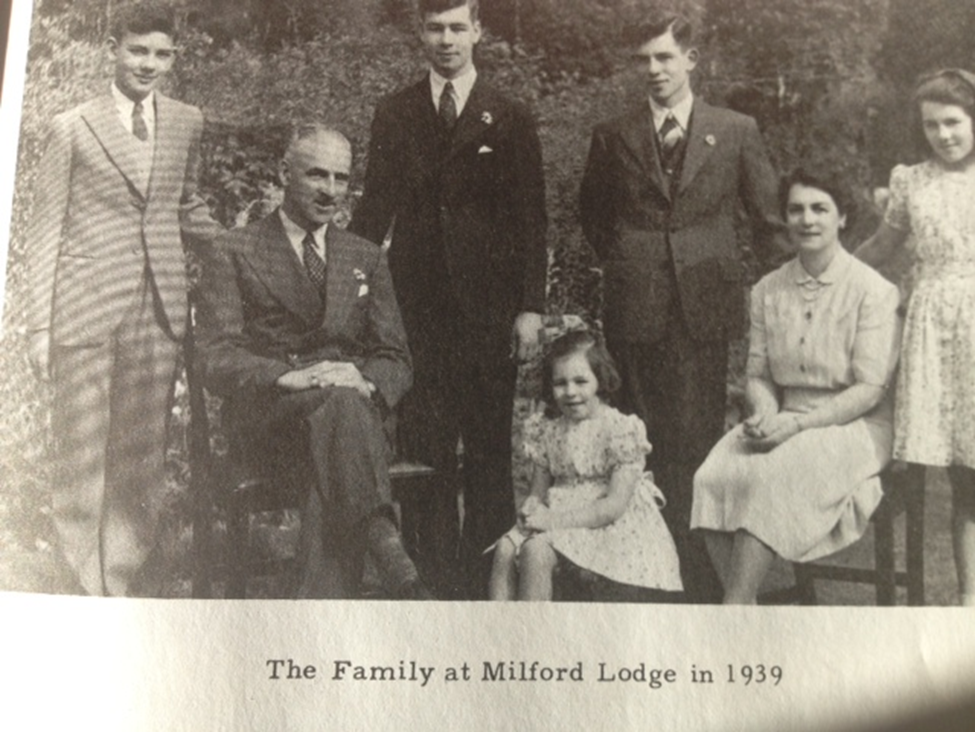
LYNNFIELD — John E. Harriss (1896-1963), international business executive, moved his young family from Lynnfield to England in 1938, where he accepted a post in the leather industry.
As World War II approached, the family decided to remain in London for the duration. During those years, Harriss wrote many letters home describing life in wartime Britain. Much of this correspondence was published in the Village Press, Lynnfield’s only newspaper at the time.
Harriss wrote the following Christmas letter to his neighbor Harry W. Munroe of Salem Street in late 1941 after Britain had experienced the ravages of the Blitz.
Dear Friends:
Christmas approaches while the war birds still hover overhead. This is not the first time that the world has seen the spirit of “Peace on Earth,” sullied by the baser acts of mankind. It is difficult to believe that the ravages of Coventry, Birmingham and Bristol, the sinkers of the child-packed “City of Benares,” are one and the same as those I have heard sing “Stille Nacht” with such feeling. Is it Jekyll and Hyde or is it man on his highest and lowest plane?
I wrote the above paragraph just a year ago, in a war letter No. 6. I think Davey Jones got most, if not all of that consignment. Many of my friends reported that they have not received it. Now once again Christmas approaches, war birds still hover overhead but they become fewer and fewer. Some of them have been scorched in the red fires of Russia, others perhaps have learned to respect the Royal Air Force, but at any rate, their visits here are diminishing. This doesn’t mean that victory is here or that peace can be seen on the horizon. But is does mean that we are better off than we were last year, thanks to the Russian Front and American assistance.
One cannot but wonder what another year will bring. We all pray that it will be “Peace on Earth,” but may it be a peace that will last, a peace during which the peoples of this world need not worry about unemployment and depression. A peace during which children can grow up with healthy bodies and healthy minds – plenty of good food and no traditional hates. A peace during which we can grow old in comfort without the worries brought on by the financial insecurity of the political ambitions of those chosen to rule.
It was three years ago in September when we landed at Liverpool. Little did we think that we would soon be in the middle of a war. The conference at Munich was in progress. Chamberlain landed at Croydon waving Hitler’s endorsement to “Peace in our Time.” Often I have wondered if Chamberlain believed it.
The next year was not unusual except for rumors of war. We were trying to get acquainted with England and it was not easy. The lack of heat in the houses, the food, the schools, the slight differences in the language, the cool reserve of the people, all took a bit of study. Jean came home in school in tears because she had been called a “Yank” and asked us what gangsters were. Even now, it is difficult to convince people that America isn’t 50 % gangsters – thanks to Hollywood.
Then came the declaration of war – the months of false security before the Marginot line – the sudden awakening which ended at Dunkirk and the determination to fight on in spite of what looked like a certain disaster. Nan (John’s wife) took courses in first aid while Jack and I joined the Home Guard. Invasion was certainly expected but it didn’t come. I bought passage home for Nan and the girls (the boys wanted to stay). When there was a last minute cancellation, Nan decided to stick it out.
It was an exciting year with air raids by day and night. From Mitford Lodge, we could see the bombing that destroyed Coventry and mutilated Birmingham. Bob and Don from their school near Bristol were treated to the sight of dog-fights in the sky and parachutes floating to the ground with their human passengers. Both Nan and I experienced London nights during the “Blitz” but we were careful never to go together. Jack (oldest son) spent days and nights in both Coventry and Liverpool doing relief work after the raids. None of us would like to go through it again, but none of us regrets having had the experience.
Now the second war year has ended and we find ourselves with different problems, but still hanging on. Jack is in the R.A.F. training to be a pilot. Nan drives a mobile canteen and I spend my evenings and Sundays drilling boys in the Air Training Corps. Food is rationed, but we seem to get enough to keep us healthy. The maids have all joined up or are making munitions. Coupons are necessary for clothing and shoes but they seem to be sufficient. The eternal black-out gets monotonous and we long to sit in the house at night with the lights blazing and the shades up, or to drive our car with the headlights full on. Gas is rationed to such an extent that I have become an expert on the bicycle (incidentally, it is good for my waistline.) Taxes but it is better not to mention them. And tonight is my night for fire watching at the factory. Believe me, I will be glad when morning comes.
In spite of it all, I don’t think we regret these last three years. We have lived a bit of history and have watched a nation “take it” and come up for more. We hope to be here for the final round, but after that has been fought and with Adolf and Benito safe in a padded cell, we hope to view once more Miss Liberty with her background of Little Old New York. We hope, collectively and singly, to visit our friends in America and thank them for their cheering letters and their thoughtful gifts and to invite them all to Milford Lodge when they come to “visit the battlefields” after the peace.
My letter must end as it commenced with the thought of Christmas and the hope that before another year has passed “Peace on Earth” will be an accomplished fact. A Merry Christmas and Happy New Year to you from us all.
Sincerely,
John F. Harriss